


The government has officially announced the Cost Inflation Index (CII) for the Financial Year 2024-25, setting it at 363. This isn't just a random number; it's a crucial figure for anyone selling a long-term capital asset in India. Up from last year's 348, this updated value directly helps you lower your tax bill by accounting for inflation.
Understanding the Cost Inflation Index for FY 2024-25
Think of the Cost Inflation Index (CII) as a government-provided tool that adjusts the original price of an asset to what it would be worth today. This process, called "indexation," ensures you're taxed on the real increase in your asset's value, not the artificial gains inflated by rising prices over the years.
Without this adjustment, your taxable profit on paper would look much bigger, leading to a much higher tax payment. The CII is the key that unlocks this powerful tax-saving benefit.

How It Protects Your Investment Gains
Imagine you bought a plot of land back in 2005. The money you paid then had far more buying power than it does today. If you sell that land now, the profit might seem huge, but a significant chunk of that "gain" is just inflation doing its thing. The cost inflation index for FY 2024-25 helps level the playing field by acknowledging this simple economic fact.
This makes the index an essential tool for smart financial planning. The Central Board of Direct Taxes (CBDT) has formally notified the new CII figure of 363 for FY 2024-25, reflecting the persistent inflation in our economy. This value is what you'll use to adjust the purchase price (or cost basis) of your assets when calculating long-term capital gains tax.
At its heart, the CII is about fairness. It stops the taxman from charging you on profits that are just an illusion created by inflation. You only pay tax on the actual, real-terms growth of your investment.
CII FY 2024-25 vs FY 2023-24 at a Glance
To put the latest update into perspective, here’s a quick comparison of the CII for the current and previous financial years. This year-on-year increase reflects the inflationary pressures on the economy.
| Financial Year (FY) | Cost Inflation Index (CII) | Year-on-Year Increase |
|---|---|---|
| 2024–25 | 363 | +4.31% |
| 2023–24 | 348 | – |
This steady rise in the index is a clear signal of why understanding and applying indexation is so important for investors looking to protect their returns from both taxes and inflation.
Using the indexation benefit correctly can make a massive difference to your final tax liability. By learning how to apply the CII, you can manage your investments more effectively and keep more of your hard-earned gains. Of course, protecting gains is one thing; generating income that beats inflation is another. If you're interested in that side of the equation, you might find our guide on how to start a passive income to offset inflation in India quite useful.
How The Official CII Number Is Determined
So, where does the official Cost Inflation Index (CII) number actually come from each year? It’s not just a figure plucked out of thin air. It’s a carefully calculated number that reflects the economic pulse of the country, ensuring the indexation benefit you get is firmly rooted in real-world data.
The entire system hinges on one key indicator: the Consumer Price Index (CPI). You've likely heard of it before. The CPI measures the average change in prices that people like us (urban consumers, specifically) pay for a standard basket of goods and services—everything from food and housing to transport. Think of it as the most widely accepted yardstick for retail inflation affecting everyday households.
The government then uses a straightforward formula to get from the CPI to the CII. The annual CII is based on 75% of the average increase in the CPI for the preceding year. This methodical approach ensures the index remains a reliable and consistent tool for taxpayers.

The Role Of The Base Year
To make these year-on-year comparisons meaningful, the whole system needs a solid starting point. This is where the base year comes in. For the current CII series, that year is the financial year 2001-02.
This base year was assigned a simple value of 100. Every single CII value that has come since, including the cost inflation index for FY 2024 25, is measured relative to this benchmark. It’s the anchor that allows for a consistent calculation of inflation’s impact over decades.
This is a bit like how the time value of money works, where a rupee today is worth more than a rupee in the future. To see this principle in action, you can play around with our time value of money calculator. The base year provides that essential "today" value for all indexation calculations.
Connecting CPI To The Final CII Number
Ultimately, India's broader inflation trends are what shape the annual CII. Since the index reflects 75% of the previous year's average CPI increase for urban areas, the moderate inflation we've seen recently has led to steady, predictable rises in the CII. That's why we saw a jump from 348 in FY 2023-24 to 363 for FY 2024-25.
The Key Takeaway: The CII isn’t a subjective figure. It’s a data-driven metric tied directly to the Consumer Price Index, giving us a transparent and fair way to adjust for inflation when calculating long-term capital gains tax.
Understanding this process should give you confidence when using the index. It’s a logical, government-mandated tool designed to make sure your capital gains tax is calculated on the real growth of your asset, not just the ghost of inflation over time. This systematic approach is what makes the indexation benefit so powerful and reliable for financial planning.
Calculating Your Indexed Cost of Acquisition
Alright, now that we have a good grasp of what the Cost Inflation Index is, let's get to the fun part: putting it to work. This is where the theory turns into real, tangible tax savings. The whole process hinges on a simple but incredibly powerful formula that adjusts your asset's original purchase price for inflation.
The result is what we call the Indexed Cost of Acquisition.
Here’s the formula that unlocks these indexation benefits:
Indexed Cost of Acquisition = Original Cost × (CII of Sale Year / CII of Purchase Year)
Let’s quickly break down each piece so it’s crystal clear.
- Original Cost: This one’s easy—it's the price you first paid for the asset.
- CII of Sale Year: This is the Cost Inflation Index for the financial year you sell the asset. For any sales happening in FY 2024-25, this magic number is 363.
- CII of Purchase Year: This is the Cost Inflation Index for the financial year you originally bought the asset.
What this calculation does is inflate your initial cost to its equivalent value today. This simple step can dramatically slash your on-paper capital gain, which means less tax for you.
This quick infographic shows the simple three-step process for figuring out your indexed cost.
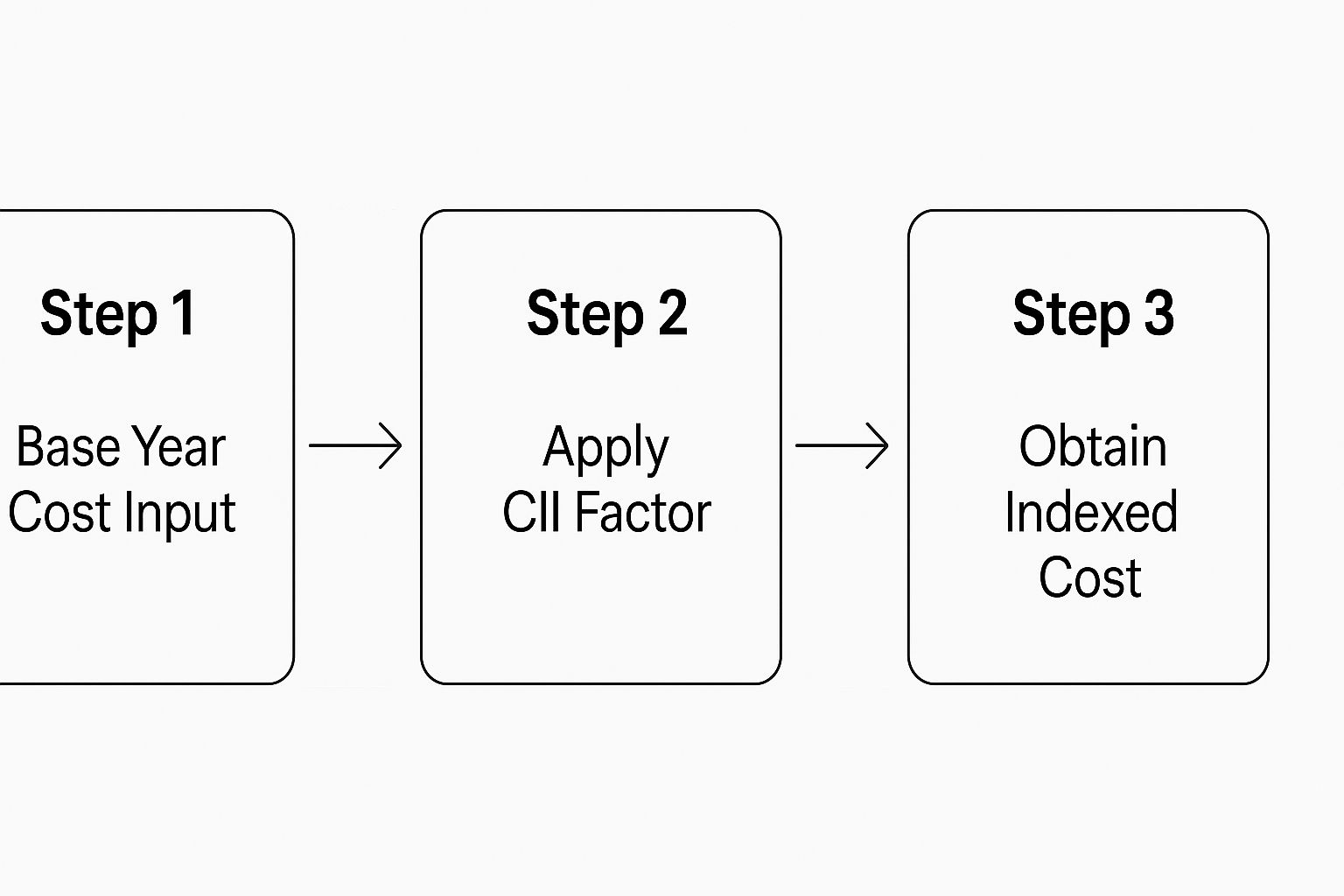
As you can see, you start with the original price, apply the CII ratio, and land on the inflation-adjusted cost. That final figure is what you'll use for your tax calculations.
Putting The Formula Into Practice
Let's walk through a couple of real-world examples to see exactly how this plays out. First, we'll look at a piece of jewellery, and then we'll apply the same logic to some unlisted shares.
Example 1: Jewellery Purchased In 2008
Imagine you bought a beautiful gold necklace back in October 2008 (that’s FY 2008-09) for ₹1,00,000. Fast forward to today, and you decide to sell it in November 2024 (FY 2024-25) for a tidy ₹4,50,000.
Without indexation, your taxable capital gain would be a whopping ₹3,50,000. Ouch.
Now, let's bring in the CII formula and see what happens.
- Original Cost: ₹1,00,000
- CII of Sale Year (FY 2024-25): 363
- CII of Purchase Year (FY 2008-09): 137
Indexed Cost = ₹1,00,000 × (363 / 137) = ₹2,64,963
With this new indexed cost, your taxable gain is now:
Sale Price (₹4,50,000) – Indexed Cost (₹2,64,963) = ₹1,85,037
Just like that, by using the cost inflation index for FY 2024 25, your taxable gain has shrunk from ₹3,50,000 to just ₹1,85,037. That’s a massive difference.
Example 2: Unlisted Shares Acquired In 2012
Let's try another scenario. Say you acquired unlisted shares in a promising startup back in May 2012 (FY 2012-13) for ₹2,00,000. You hold onto them and finally sell in January 2025 (FY 2024-25) for ₹7,00,000.
- Original Cost: ₹2,00,000
- CII of Sale Year (FY 2024-25): 363
- CII of Purchase Year (FY 2012-13): 200
Indexed Cost = ₹2,00,000 × (363 / 200) = ₹3,63,000
Your new taxable capital gain becomes:
Sale Price (₹7,00,000) – Indexed Cost (₹3,63,000) = ₹3,37,000
Without indexation, your gain would have been ₹5,00,000. These examples make it obvious how indexation acts as a shield, protecting your investment returns from being eaten away by both inflation and taxes. This same principle applies to other assets like property; if you're an investor, our ultimate guide to rental property management in India offers more insights into maximising returns.
Which Assets Qualify for Indexation Benefits
So, you've heard about this powerful tax-saving tool called indexation. But here's the catch: it doesn't apply to everything you own. Figuring out which of your investments get this benefit is a crucial step in smart tax planning, helping you calculate your long-term capital gains accurately and avoid any nasty surprises come tax season.
At its core, the indexation benefit is designed for long-term capital assets. This generally means assets you've held for a specific period—more than 24 months for property like land or buildings, and more than 36 months for assets like jewellery or unlisted shares. The cost inflation index for FY 2024-25 is the key that unlocks the tax-saving potential on these long-term holdings.

Eligible Assets for Indexation
Alright, let's get down to brass tacks. Which specific assets actually make the cut? While the full list is quite extensive, here are the most common long-term assets that qualify for the indexation benefit:
- Immovable Property: This is a big one, covering land, buildings, and residential houses.
- Jewellery and Bullion: Your gold, silver, platinum, and other precious metals, including any ornaments made from them, are eligible.
- Unlisted Shares: If you own shares in companies that aren't traded on a recognised stock exchange in India, you can claim indexation.
- Bonds and Certain Debentures: Specific types of debt instruments also qualify, though the rules here can get a bit tricky.
- Archaeological Collections: Valuables like unique sculptures, drawings, and paintings are also on the list.
Key Assets That Are Excluded
Knowing what doesn't qualify is just as important. The taxman has carved out specific exceptions for assets that have their own tax treatment.
Important Note: Indexation is exclusively for calculating long-term capital gains. You can't apply it to any short-term capital gains, no matter what type of asset you've sold.
Here are the key assets that are left out of the indexation party:
- Listed Equity Shares and Equity Mutual Funds: These fall under Section 112A, which has a different rulebook. Gains over ₹1 lakh are taxed at a flat 10% without any indexation benefit.
- Debt Mutual Funds (Post April 2023): There was a major rule change here. Gains from debt funds bought after 1st April 2023 are now treated as short-term capital gains and taxed at your income slab rate, stripping them of the indexation advantage.
- Digital Assets: The tax rules for assets like cryptocurrency are a different ballgame altogether. For a deeper dive, check out our guide on cryptocurrency payments and taxes for Indian freelancers.
The tax landscape is always shifting, and a recent policy change has shaken things up. During the Union Budget 2024 speech, Finance Minister Nirmala Sitharaman announced significant updates to capital gains rules. While indexation continues for assets like jewellery and bonds, it has been removed for property sales—a major shift for real estate investors. Staying on top of these changes is absolutely vital for your financial planning.
Common Mistakes to Avoid When Using the CII
Applying the Cost Inflation Index (CII) correctly is your ticket to some pretty serious tax savings. But a few common slip-ups can easily throw your calculations—and your tax return—into chaos.
Getting it right the first time saves you from headaches with the tax authorities down the line. Think of this as your essential checklist for dodging the most frequent errors.
The most common mix-up? Confusing the financial year (FY) with the assessment year (AY). It's an easy mistake to make, but a costly one. The indexation formula always uses the CII of the financial year in which you sold the asset. So, for any sale between 1st April 2024 and 31st March 2025, you must use the cost inflation index for FY 2024-25, which is 363.
Applying Indexation Incorrectly
Another major pitfall is trying to apply the indexation benefit to short-term capital assets. This is a non-starter.
Indexation is a privilege reserved exclusively for long-term capital gains. The benefit is designed to account for inflation over an extended holding period, so it cannot be used to reduce tax on assets held for a short duration.
This distinction is fundamental to capital gains tax in India. Before you even think about the formula, make sure your asset actually qualifies as long-term.
Misidentifying the year of acquisition is another frequent source of error, especially with inherited property. When you inherit an asset, its "cost to the previous owner" becomes your cost. The year they originally bought it becomes your purchase year for CII purposes.
Other Common Errors to Watch Out For
To keep your calculations clean and accurate, steer clear of these additional mistakes:
- Forgetting the Base Year Rule: For any asset bought before 1st April 2001, you have to use the CII of the base year (FY 2001-02), which is 100. You can use the Fair Market Value as of that date for your cost, but the purchase year CII is locked in at 100.
- Applying CII to Ineligible Assets: Remember, indexation doesn't apply to everything. Listed equity shares, equity mutual funds, and most debt funds acquired after April 2023 are out. Applying the benefit here will definitely lead to scrutiny.
- Simple Calculation Errors: It sounds obvious, but simple maths mistakes can be expensive. Always double-check your figures when plugging them into the formula.
Navigating all these rules can sometimes feel overwhelming. If you're finding it tricky, it might be wise to get some professional guidance. Understanding when to hire a financial advisor versus DIY investing can be a crucial decision for your financial health and tax compliance.
Got Questions About the CII? We've Got Answers.
Here, we tackle some of the most common questions that pop up around the Cost Inflation Index for FY 2024-25. Think of this as a practical guide to handling those tricky, real-world scenarios that often leave taxpayers scratching their heads when it's time to calculate capital gains.
What if I Bought an Asset Before the 2001-02 Base Year?
This is a classic question, especially for long-term investors holding assets for decades. If you bought something before 1st April 2001, the Income Tax Act cuts you a bit of a break. You get to choose between its actual purchase price or its Fair Market Value (FMV) as of that date.
Naturally, you'll pick whichever is higher. That higher value becomes your new starting point for calculating indexation.
When you plug this into the formula, you’ll use the base year's CII, which is 100, as the 'CII of Year of Purchase'. This rule is in place to make sure that people holding very old assets aren't penalised for inflation that happened long before the modern index even existed.
Can NRIs Use the CII for Indexation Benefits?
Absolutely. Non-Resident Indians (NRIs) are on the same footing as resident Indians here. They can fully claim indexation benefits on long-term capital gains when selling eligible assets in India. The calculation method is exactly the same.
There are just a couple of procedural things to keep in mind:
- For NRIs, capital gains are subject to Tax Deducted at Source (TDS) when the sale happens.
- To actually claim the indexation benefit and get any potential refund, the NRI has to file an Indian income tax return.
So, while the benefit is definitely there for the taking, proper compliance is the key to making it work. The core idea of adjusting for inflation, including using the cost inflation index for FY 2024-25, doesn't change.
Does the CII Apply to Listed Shares or Equity Mutual Funds?
No, it doesn't. You can't use the Cost Inflation Index for gains from listed equity shares or equity-oriented mutual funds. These popular investments play by a different set of rules, laid out in Section 112A of the Income Tax Act.
Under this rule, any long-term capital gains over the yearly exemption limit of ₹1 lakh get taxed at a flat 10%. The most important part? This is calculated without any indexation benefit.
This separate tax treatment was brought in to simplify things for capital market investments. It means you can't use the CII to pump up your purchase cost for these specific assets. The rules are completely different and need to be applied that way.
Where Is the Official CII Notification Published?
The official announcement for the CII is a formal affair. The Central Board of Direct Taxes (CBDT), which is part of the Ministry of Finance, is the organisation in charge.
Every year, the CBDT announces the new CII value through a notification published in the Official Gazette of India. If you want the information straight from the source, you can find these announcements on the Income Tax Department of India's website under the 'Notifications' section. Shortly after, you'll see the number pop up in all major financial news outlets and tax advisory updates.
At Money Mattr, we believe that understanding concepts like the Cost Inflation Index is the first step towards building real wealth. Our platform is dedicated to providing clear, practical financial education to help you manage your money with confidence. Explore more guides and tools at https://moneymattr.com.