


Calculating your return on investment, or ROI, is a surprisingly simple way to figure out if something was profitable. The basic formula is just (Net Profit / Cost of Investment) × 100%. This gives you a clean percentage showing exactly how much you gained or lost compared to what you put in.
What Is Return on Investment and Why It Matters

Think of ROI as your financial report card. For freelancers and small business owners in India, it’s the most direct way to know if your hard work and capital are actually paying off. It cuts through all the noise and answers one simple question: was this worth it?
Understanding ROI is the first real step toward making your money grow. Whether you’re a freelance designer buying new software or a small shop owner in Bangalore running a social media ad campaign, ROI helps you make smarter decisions. It gives you the hard data to answer critical questions like:
- Which of my marketing efforts are actually bringing in money?
- Should I hold onto this stock or is it time to sell?
- Did that expensive new piece of equipment really improve my bottom line?
The Core Formula Explained
While the formula looks simple on paper, applying it in the Indian context means paying attention to the details. For example, if you invest in a property in Mumbai, your "cost" isn't just the purchase price; you have to factor in stamp duty, registration fees, and ongoing maintenance.
Let's break it down with a quick example. Imagine you bought a property for ₹1 crore. After all associated costs like fees and maintenance, your total investment comes to ₹1.05 crore. You later sell it for ₹1.25 crore.
Your net profit here is ₹20 lakh (₹1.25 crore – ₹1.05 crore).
So, the ROI would be (₹20 lakh / ₹1.05 crore) × 100%, which works out to a 19.04% return. This basic calculation can be adapted to almost any financial decision you make.
To give you a clearer picture, here’s a quick rundown of the terms.
ROI Formula Components Explained
| Component | What It Means | Simple Example |
|---|---|---|
| Net Profit | The total money you made after subtracting all costs. | Selling a product for ₹1,500 that cost you ₹1,000 to make and market. Your net profit is ₹500. |
| Cost of Investment | The total amount of money you spent to make the investment happen. | The ₹1,000 you spent on materials and advertising for that product. |
| ROI Percentage | The final result, showing your return as a percentage. | (₹500 / ₹1,000) x 100% = 50% ROI. |
Getting this calculation right is fundamental for anyone serious about managing their money.
Key Takeaway: ROI isn't just a term for big corporations. It's a practical, everyday tool for business owners and individual investors to measure success, justify spending, and decide where to put their money next for the best results.
If you're just starting to think about making your money work for you, our guide on how to start investing offers the perfect foundational knowledge to go along with these principles.
A Practical Guide to Calculating Your ROI
Alright, let's get down to brass tacks. Moving from theory to action, calculating your return on investment is less about fancy maths and more about being brutally honest with your numbers. The first, and most critical, step? Nailing down every single cost tied to your venture.
It’s easy to focus on the big-ticket price, but it's the little hidden expenses that can completely skew your perception of profitability.
This whole process kicks off with a detailed list of every rupee you've spent. Let’s say you're a freelance designer in Chennai who just invested in some shiny new design software. Your costs aren't just the licence fee. You absolutely have to include:
- The training and setup costs for getting the hang of the new tool.
- Any monthly subscription fees or annual maintenance charges.
- Associated hardware upgrades needed to run the software without it crashing.
- The value of your time spent getting everything up and running.
Or think about a local kirana store in Pune launching a delivery service. Their investment goes far beyond just the delivery vehicle. Their total cost must account for fuel, insurance, marketing pamphlets, and even the salary of the delivery person.
Totalling Your Investment Costs
Once you have that complete list, adding it all up gives you your "Total Cost of Investment." This number is the foundation of the ROI formula; it's your real starting point. If you miss even one small cost, you’ll artificially inflate your ROI percentage and give yourself a false sense of success.
This flow diagram breaks the whole calculation down into three simple stages.
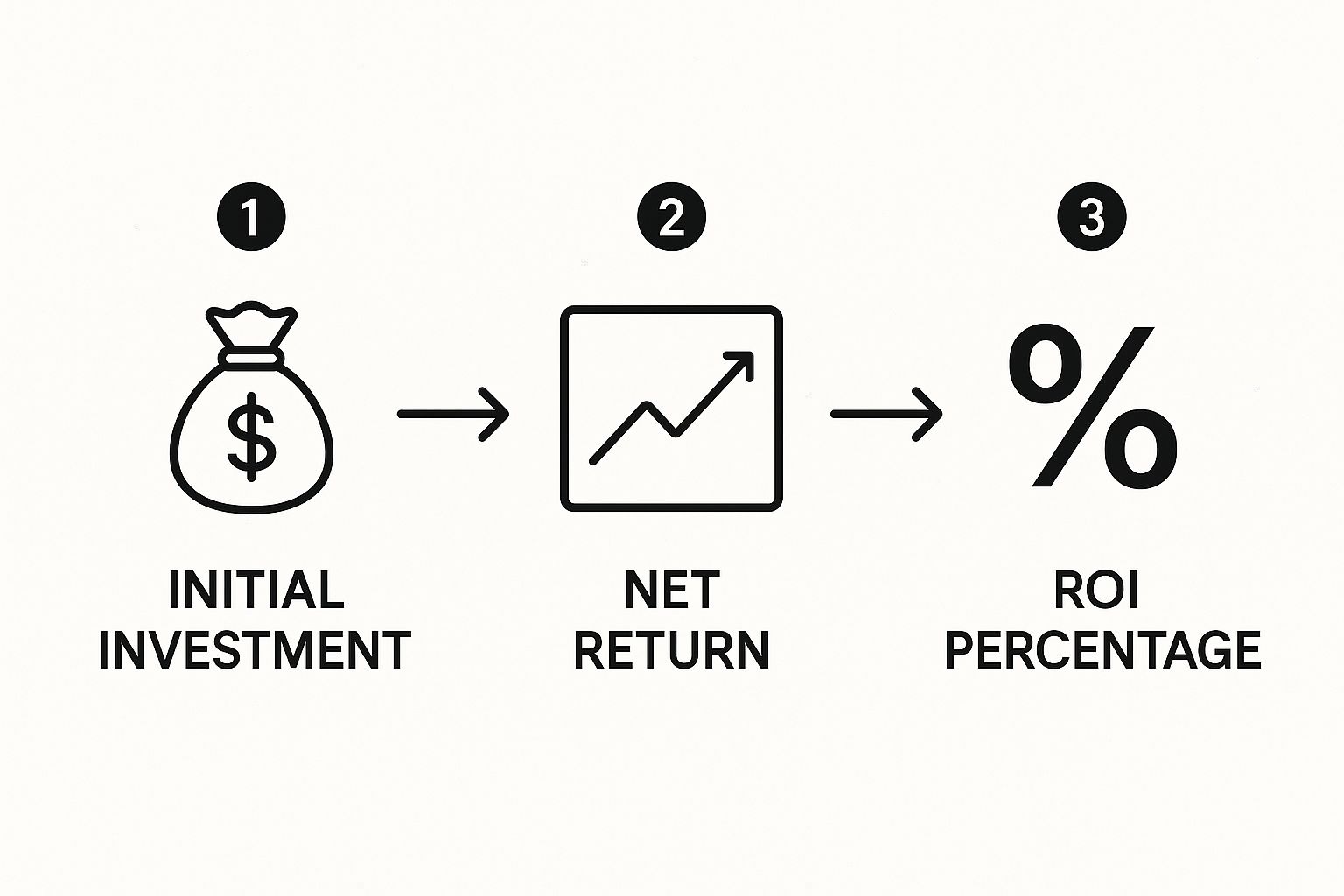
As you can see, getting an accurate ROI hinges on precisely tracking both what you put in and what you get out.
Determining Your Net Return
With your costs tallied, it's time to figure out your total return or gain. This is the "Net Profit" part of the ROI equation.
For our freelance designer, this would be the extra income earned from projects that were only possible because of the new software. For the kirana store, it’s the profit from all those new delivery orders.
To get your net profit, you simply subtract your total investment cost from the total revenue generated by that investment.
Key Insight: A common mistake is to only track direct revenue. Don't forget to factor in cost savings. If a new machine cuts your production costs by ₹10,000 a month, that saving is absolutely part of your return.
It's also worth remembering that the timing of your returns makes a difference. A return you earn today is more valuable than the same amount earned a year from now. This is a concept you can explore further with a time value of money calculator. Calculating your net return accurately is the only way to ensure your ROI reflects the true financial impact of your decision.
Applying The ROI Formula To Different Investments
The basic ROI formula is a great starting point, but its real magic lies in how you adapt it to different kinds of investments. Knowing how to calculate return on investment isn't just about memorising a formula; it's about understanding which numbers to use.
Each investment type, from stocks to property, has its own unique costs and returns that you need to track meticulously.
Take the stock market, for instance. Your initial cost is more than just the share price. You have to factor in brokerage fees, securities transaction tax (STT), and any annual maintenance charges for your Demat account. Likewise, your return isn't just the final sale price—it also includes any dividends you earned along the way.
Key Takeaway: A truly accurate ROI calculation requires a complete picture of every rupee coming in and going out. If you overlook small costs or forget ancillary returns, you’ll end up with a misleading view of your investment's real performance.
Let's break down how this works for some of the most common investments in India.
Calculating ROI On Real Estate
Investing in property is a classic example where the purchase price is just the tip of the iceberg. To calculate your true investment cost, you need to account for several other significant expenses.
To get the real number, make sure you add up:
- The purchase price of the property itself.
- Stamp duty and registration charges, which can be a hefty percentage.
- Brokerage fees paid out to the real estate agent.
- Costs for any renovations or repairs you did before selling or renting it out.
- Annual maintenance charges and property taxes paid while you owned it.
On the other side of the equation, your total return is the final sale price plus any rental income you collected. Without factoring in all those extra costs, your ROI will look much rosier than it actually is. Managing these details is crucial, and you can find more strategies in our ultimate guide to rental property management in India.
Measuring Digital Marketing Campaign ROI
For any small business owner, figuring out the ROI on a marketing campaign is non-negotiable. Let’s imagine a local clothing brand in Jaipur decides to spend ₹50,000 on a targeted Instagram ad campaign.
The total investment cost isn't just the ad spend. You also have to include the cost of creating the ad visuals and writing the copy. Let's say that's another ₹10,000, bringing the total marketing cost to ₹60,000.
Now for the returns. The campaign directly brings in ₹2,00,000 in new sales. But we can't stop there. The cost to produce the clothes that were sold was ₹80,000. This means the actual profit from those sales is ₹1,20,000 (₹2,00,000 – ₹80,000).
Let’s plug it all into the formula:
- Net Return: ₹1,20,000 (Profit) – ₹60,000 (Marketing Cost) = ₹60,000
- ROI: (₹60,000 / ₹60,000) x 100 = 100%
This simple calculation tells the owner that for every single rupee they spent on the campaign, they earned one rupee back in pure profit. That's a powerful insight.
Defining a Good ROI in the Indian Market
You’ve run the numbers and now you have a percentage staring back at you. So, what does it actually mean? Is a 12% ROI fantastic, average, or just plain disappointing?
Honestly, the answer is always: it depends.
There's no magic number for a "good" ROI. It’s completely relative. You have to weigh it against the risk you took on, how long your money was locked in, and what other options are out there in the Indian market. It’s like comparing apples and oranges—you simply can't put the returns from a high-risk tech startup against the interest from a safe fixed deposit.
For example, an 8% annual ROI from a low-risk government bond is a solid win. But if you’d put that same money into a volatile small-cap stock, you’d be hoping for something much higher, maybe upwards of 20%, to make the risk of losing it all worthwhile.
Benchmarking Your Performance
To get a real sense of how your investments are doing, you need to compare them to relevant benchmarks. This gives you a realistic yardstick to measure whether your decisions are actually paying off.
Here are a few common benchmarks in the Indian market to keep in mind:
- Fixed Deposits (FDs): Typically offering 6-8%, FDs are your baseline for a very low-risk return.
- NIFTY 50 Index: Historically, the NIFTY 50 has delivered average annual returns of around 12-15% over the long haul, making it a great benchmark for your equity investments.
- Real Estate: While returns can be all over the place, a rental yield of 3-5% plus property appreciation in a Tier-2 city is a reasonable expectation.
Expert Insight: At the end of the day, your personal financial goals are the ultimate benchmark. If an ROI is helping you comfortably hit your targets, then it’s a good one, no matter how it stacks up against the broader market.
The bigger economic picture matters, too. Right now in India, sectors like IT, manufacturing, and renewable energy have been showing strong performance, often clocking ROIs over 15% annually. This has naturally pulled in a lot of foreign investment. Keeping an eye on these trends helps you set more realistic forecasts.
Ultimately, you have to decide whether you're comfortable tracking these benchmarks yourself or if it's time to bring in a professional. Knowing when to hire a financial advisor versus DIY investing can make all the difference in setting achievable ROI targets that truly fit your financial life.
Common Mistakes When Calculating ROI
It's surprisingly easy to get ROI calculations wrong. A small error at the start can completely warp your understanding of a project's success, leading to some pretty bad business decisions down the line. Even seasoned entrepreneurs can trip up on a few common oversights.
Let’s be honest, we’ve all done it—focused so much on the big, upfront purchase price that we forget all the other "soft costs" that creep in. Things like taxes, labour hours, operational expenses, and ongoing maintenance fees can quickly add up and inflate your actual investment cost.
Key Insight: Before you spend a single rupee, make a detailed checklist of every possible cost. Think through everything from the initial setup to long-term upkeep. If your starting investment number is wrong, your final ROI will be meaningless.
Another classic mistake is getting the timeline wrong. This one can seriously distort how good a return actually is.
Misjudging The Investment Timeline
A 15% ROI looks fantastic on paper, but it tells a very different story if it took five years to achieve versus just one. This is why you should always annualise your returns. It’s the only way to make a fair, apples-to-apples comparison between different investments.
Annualising helps you see the real-world performance of your money. For context, sector-specific studies on Indian manufacturing projects often show annualised returns between 12% and 18% during stable economic periods. That gives you a solid benchmark to aim for.
Finally, a lot of business owners forget to account for the non-financial costs and benefits that add crucial context to the final number.
- Your Time: How many hours did you personally sink into this? Your time has value.
- Opportunity Cost: What was the next best thing you could have done with that money?
- Brand Value: Did this investment boost your business's reputation or open new doors?
These "invisible" factors are just as important as the hard numbers. Without tracking them, you're only getting half the picture. A detailed financial analysis is vital, as poor financial tracking is one of the main reasons so many ventures fail. You can learn more about this in our deep dive on why most Indian side hustles fail financially.
Your ROI Questions, Answered
As you get more comfortable with calculating ROI, a few common questions are bound to pop up. Let's tackle some of the ones I hear most often from freelancers and business owners.
How Is ROI Different From Other Metrics Like ROE?
People often mix up ROI (Return on Investment) with ROE (Return on Equity). While they both measure profitability, they’re looking at it from different angles.
Think of it this way: ROI is a broad measure of how much profit you made compared to the total cost of your investment. ROE, on the other hand, is much more specific. It measures how well a company is using the money invested by its shareholders to generate profits. For a freelancer or a small business in India, ROI is usually the more practical day-to-day metric.
What if I Haven't Sold My Investment Yet?
This is a great question. What if you've invested in something—say, a piece of equipment or some stocks—but you haven't sold it yet? How do you know if it's performing well?
In this scenario, you can calculate an estimated or "unrealised" ROI. You simply use the asset’s current market value instead of a final sale price in the formula. This gives you a valuable snapshot of its performance right now, even if you don't have the cash in hand.
I Calculated My ROI and It's Negative. What Now?
Seeing a negative number can be disheartening, but don't panic. A negative ROI simply means your costs were higher than your returns, leading to a loss on that particular investment.
Instead of seeing it as a failure, treat it as a learning opportunity. Now’s the time to dig into the details. Were your initial costs way too high? Did the returns fall short of your projections? Pinpointing what went wrong is the first step to refining your strategy and making sure you don’t repeat the same mistakes on your next venture.