


Becoming a millionaire in India isn’t some far-fetched fantasy. It’s a real, achievable goal built on a foundation of disciplined saving, smart investing, and finding ways to earn more. Forget the lottery-ticket mindset; this is about following a consistent financial roadmap.
The secret sauce? Combining intelligent financial habits with the incredible opportunities popping up in India's fast-growing economy.
The New Indian Dream: Decoding Your Path to a Million

For many Indians, the ambition to build serious wealth is no longer a pipe dream—it’s a practical objective. The country's economic landscape is shifting under our feet, opening up new pathways to prosperity that just weren't there a decade ago. This journey has little to do with luck and everything to do with adopting the right mindset and a clear, actionable strategy.
The whole story of wealth creation in India is changing. We're seeing an incredible surge, with projections showing the country will have 871,700 millionaire families by 2025. That's a mind-boggling 445% growth since 2017, signalling a powerful upward economic shift.
This isn't just a story for the ultra-rich. This growth is being driven by everyday professionals, entrepreneurs, and savvy investors from all walks of life. You can dive deeper into this wealth expansion in the Mercedes-Benz Hurun India Wealth Report 2025.
Key Pillars for Becoming a Millionaire in India
To navigate this journey, you need a solid foundation. The table below outlines the core strategies that are non-negotiable for anyone serious about building significant wealth in India. Think of these as the building blocks of your financial future.
| Pillar | Description | Why It's Critical |
|---|---|---|
| Financial Mastery | Getting a tight grip on your money through budgeting, eliminating high-interest debt, and building a solid emergency fund. | This is the bedrock. Without control over your cash flow, investing and growing your income becomes nearly impossible. |
| Income Diversification | Moving beyond a single salary by creating multiple income streams, from side hustles to more passive projects. | Relying on one source of income is risky. Multiple streams provide a financial safety net and accelerate wealth accumulation. |
| Strategic Investing | Making your money work for you by investing in stocks, mutual funds (SIPs), and real estate to harness the power of compounding. | Earning money is only half the battle. Your wealth truly grows when your money starts earning money on its own, 24/7. |
This guide is your roadmap. We’ll break down each of these pillars into practical, manageable steps tailored specifically for the Indian context. Let’s move beyond theory.
Here's a quick look at what we’ll cover:
- Mastering Your Finances: This is ground zero. We're talking about a budget that actually works, a plan to crush high-interest debt, and building an emergency fund that lets you sleep at night.
- Boosting Your Income: Depending on just your salary is the slow lane to wealth. We’ll explore how to create multiple income streams, from weekend side hustles to projects that generate passive income.
- Strategic Investing: Earning is one thing; making that money grow is another. This means getting comfortable with stocks, mutual funds (SIPs), real estate, and truly understanding the magic of compounding. For couples on this journey, our guide on five steps to achieve FIRE for Indian couples offers some fantastic, complementary insights.
"Your financial future isn't determined by how much money you make, but by how much money you keep and how hard it works for you."
Ultimately, the path to becoming a millionaire in India demands a mental shift. You need to move from being just a consumer to becoming an owner and an investor. It's about building financial systems that work for you around the clock, paving the way to true, long-term freedom.
Building Your Financial Foundation Before You Invest

Jumping straight into the stock market without a solid financial base is like trying to build a skyscraper on sand. It’s a recipe for disaster. Before you even dream of generating wealth, you have to get your own money in order.
This groundwork isn't glamorous, I know. But it's the single most important step on your journey to becoming a millionaire in India.
It all starts with taking total control of your cash flow. You need to know exactly where every single rupee comes from and where it disappears. This clarity is non-negotiable—it's what empowers you to make smart, intentional decisions instead of just reacting to financial surprises.
Without this control, any gains you make from investments can be wiped out in an instant by an unexpected bill or crippling debt payments.
Master Your Money With A Dynamic Budget
The word "budget" probably makes you think of restrictive spreadsheets and saying no to everything fun. Let's ditch that old-school idea. A modern, dynamic budget is a tool for freedom, not a cage. It’s simply a plan to make sure your spending aligns with your goals—like building serious wealth.
Think of it as a roadmap for your money. You can use simple apps like Walnut or Money Manager to track everything automatically, or just go old-school with a notebook. The best system is the one you'll actually stick with.
Once you see the patterns, you can start trimming the fat without sacrificing your quality of life. For a step-by-step walkthrough, our guide on how to create your first monthly budget is the perfect place to start.
A budget is telling your money where to go instead of wondering where it went. It’s the difference between being the driver of your financial life and just being a passenger.
Aggressively Eliminate High-Interest Debt
High-interest debt is the sworn enemy of wealth creation. Things like credit card debt, with interest rates that can soar past 35% annually, and personal loans are like financial quicksand. They pull you down faster than you can climb out.
Just paying the minimums is a trap. It guarantees you'll stay stuck in a debt cycle for years, sometimes even decades, with most of your payment going straight to interest.
To break free, you need to get aggressive. Two popular strategies work wonders:
- The Avalanche Method: You hammer away at the debt with the highest interest rate first while making minimum payments on everything else. Mathematically, this saves you the most money over time.
- The Snowball Method: You focus on paying off the smallest debt first, regardless of the interest rate. Scoring that quick win gives you a powerful psychological boost to keep going.
Pick the method that fires you up and commit to it. Every extra rupee you throw at these debts is a direct investment in your future, freeing up cash that you can later channel into wealth-building investments.
Build Your Financial Fortress: An Emergency Fund
Life is unpredictable. A medical emergency, a sudden job loss, or a major car repair can happen to anyone, at any time.
Without a safety net, you’d be forced to sell your investments at the worst possible moment or take on more high-interest debt, completely derailing your progress.
An emergency fund is your financial fortress. This is a stash of cash, completely separate from your investments, that covers 3 to 6 months of your essential living expenses.
This money needs to be liquid and easy to access, so keep it in a high-yield savings account or a liquid mutual fund. Building this fund should be your top priority right after you've dealt with your high-interest debt.
Set up an automatic monthly transfer to your emergency fund account, even if it’s a small amount. This disciplined habit ensures that when life throws a curveball, you’re ready to handle it without wrecking your long-term millionaire goals.
Looking Beyond a Single Salary to Speed Up Your Income

If you're only relying on one salary, you're taking the slow, scenic route to building wealth. Sure, it feels steady, but it’s also a bottleneck. To really fast-track your journey to becoming a millionaire in India, you have to break free from the single-paycheck mindset and start building multiple income streams.
This isn’t about working yourself into the ground. It's about strategically creating new channels for money to flow in, ones that can grow right alongside your main job. Some might need your active effort to get going, while others can become more passive over time, bringing in cash while you focus elsewhere.
Monetise Your Core Skills
The easiest place to start is with what you already know. Those professional skills you use from 9-to-5 are often your most valuable and marketable assets. The trick is to just repackage them for a different audience.
For example, a software developer can easily pick up freelance coding projects on weekends. A marketing manager could offer social media consulting to local small businesses. A talented writer can create content for startups that don't have an in-house team yet. These opportunities are everywhere if you know where to look.
Think about your core skills and ask yourself:
- Who else could use this skill outside of my current company?
- Could I offer this as a one-off project, an ongoing service, or even a training session?
- How do I find my very first client? (Hint: Start with your professional network on LinkedIn).
This approach doesn't just boost your income; it also sharpens your primary skills, making you even more valuable in your day job.
The goal isn’t just about earning more money. It's about creating independent financial streams. Each new stream is another layer of security and another accelerator on your path to wealth, making you less dependent on a single employer.
Build Digital Assets for Passive Income
While active side hustles are a direct trade of your time for money, passive income streams work to break that link. Building digital assets is a fantastic way to do this. These are products you create once that can be sold over and over with minimal ongoing effort.
This could be an ebook on a topic you're an expert in, an online course teaching a specific skill you've mastered, or even a niche blog that earns from affiliate marketing. The initial effort can be pretty intense, but the payoff is a revenue source that works for you around the clock.
Think about the graphic designer from Bengaluru who spent a few months creating a set of premium design templates. After launching them on a digital marketplace, those templates now generate a consistent monthly income. This frees up her time to focus on higher-value client work. You can find more ideas in our guide on how to create a second source of income in India.
This shift towards multiple income sources is a huge part of wealth creation in modern India. Between 2017 and 2025, India's millionaire households shot up at a staggering rate of 445%. This explosive growth isn't just happening at the very top; it shows a broader economic shift where entrepreneurship and diverse income opportunities are helping more people build serious wealth from the ground up.
The Gig Economy and Beyond
The rise of platforms like Upwork, Fiverr, and Urban Company has made it easier than ever to find side gigs that fit your schedule. Whether it's tutoring, pet-sitting, or offering specialised professional services, the gig economy provides a flexible way to add another layer to your income.
Your journey to becoming a millionaire in India will speed up significantly based on how effectively you can multiply your earning potential. Start small, test out an idea, and then scale what works. Each new income stream you build is another powerful step toward your financial independence.
Making Your Money Work for You Through Smart Investing
Earning a good income is a fantastic start, but it won't make you a millionaire on its own. The real magic happens when your money starts working for you, generating even more money while you sleep. This is the whole point of investing, and it's the most powerful engine for wealth creation you have.
The journey to becoming a millionaire in India is paved with smart, consistent investment decisions. It’s all about putting your capital into assets that can grow significantly over time, turning your savings into a formidable fortune.
This might sound complicated, but the basic ideas are pretty straightforward. You just need to understand your options, balance risk with reward, and let the incredible power of compounding do the heavy lifting for you.
The Power of Compounding: Your Greatest Ally
Albert Einstein supposedly called compound interest the eighth wonder of the world. Whether that's true or not, the power of compounding is very real. It’s the process where the returns on your investment start earning their own returns, creating a snowball effect that leads to exponential growth over time.
Imagine you invest ₹1 lakh. In the first year, it earns a 12% return, giving you ₹12,000. The next year, you’re not just earning a return on your initial ₹1 lakh, but on ₹1,12,000. This cycle repeats, year after year, with your money growing at an accelerating rate. The key takeaway? The earlier you start, the more time compounding has to work its magic.
Building a Diversified Indian Investment Portfolio
You've probably heard the old saying: never put all your eggs in one basket. This is the golden rule of investing. Diversification is your best friend when it comes to managing risk. By spreading your money across different types of assets, you shield your portfolio from the poor performance of any single investment.
A solid portfolio for an aspiring Indian millionaire should probably include a mix of the following.
Equities: Stocks and Mutual Funds
Historically, nothing has beaten equities for long-term wealth creation. You can get in on the action in two main ways:
- Direct Stocks: This means buying shares of individual companies like Reliance, TCS, or HDFC Bank. It offers high potential returns but also comes with higher risk and requires a fair bit of research on your part.
- Mutual Funds (SIPs): For most people, this is the way to go. A Systematic Investment Plan (SIP) lets you invest a fixed amount regularly into a mutual fund. These funds pool money from tons of investors to buy a diverse portfolio of stocks. It’s disciplined, averages out your purchase cost, and saves you from the stress of trying to time the market.
Real Estate: A Tangible Asset
Real estate has always been a favourite investment for Indians, and for good reason. It’s a tangible asset that can both generate rental income and appreciate in value over time. As India's population of high-net-worth individuals grows, so does the demand for premium property.
This rapid creation of millionaire households in India is changing investment preferences. Luxury real estate is still a top choice in hubs like Mumbai and Bengaluru, but we're also seeing a growing trend towards second homes in places like Goa. It's a mix of lifestyle aspiration and a smart move for asset appreciation.
The chart below shows just how dramatically cutting back on expenses can boost the savings you have available for these kinds of investments over just six months.
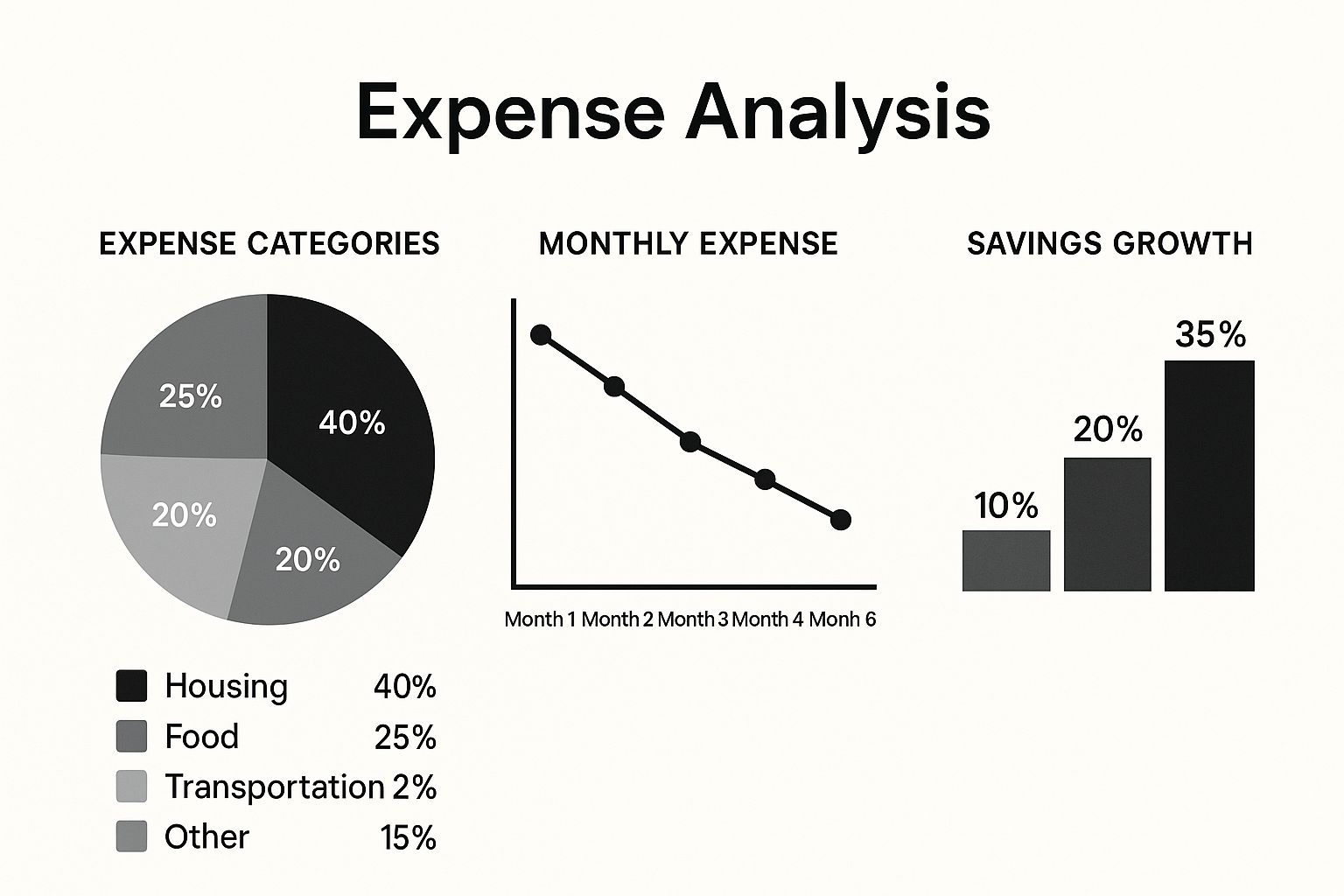
As you can see, even small, consistent cuts in your monthly spending can free up significant capital that can be funnelled directly into wealth-building assets.
Gold: An Evergreen Hedge
Gold holds a special place in Indian culture and finance. It acts as a great hedge against inflation and economic uncertainty. While it might not deliver the explosive growth you see in equities, having some of your portfolio in gold (whether through Sovereign Gold Bonds, Gold ETFs, or physical gold) can bring much-needed stability during volatile market periods.
"The stock market is a device for transferring money from the impatient to the patient." – Warren Buffett
This quote from Buffett perfectly sums up successful long-term investing. The secret is to choose your investments wisely, stay disciplined, and give them the time they need to grow.
If you’re just starting out and feeling a bit overwhelmed, our guide on how to start investing is a fantastic, detailed roadmap. Building your knowledge is the first real step toward building your fortune.
Investment Options in India: A Comparative Look
Choosing where to put your money can be tough with so many options out there. To simplify things, I've put together a quick comparison of the most popular investment avenues in India. This should give you a clearer picture of what might work best for you based on your goals and how much risk you're comfortable with.
| Investment Avenue | Average Expected Return | Risk Level | Best For |
|---|---|---|---|
| Equity Mutual Funds (SIP) | 12-15% p.a. (long term) | High | Long-term wealth creation, young investors with a high-risk appetite. |
| Direct Stocks | 15-20%+ p.a. (variable) | Very High | Experienced investors who can research and monitor companies. |
| Real Estate (Residential/Commercial) | 8-12% p.a. (appreciation + rent) | Medium | Investors looking for tangible assets and a combination of capital growth and rental income. |
| Public Provident Fund (PPF) | ~7.1% p.a. (tax-free) | Low | Risk-averse investors, tax saving, and long-term goals like retirement. |
| Gold (SGBs, ETFs) | 6-8% p.a. (inflation hedge) | Low to Medium | Portfolio diversification and hedging against market volatility. |
| Fixed Deposits (FDs) | 5-7.5% p.a. | Very Low | Conservative investors, short-term goals, and creating an emergency fund. |
Ultimately, the best strategy is often a mix of these. A well-balanced portfolio combines high-growth assets like equities with stable, lower-risk options like PPF or gold. This approach helps you capture market upsides while protecting your capital during downturns.
Adopting the Mindset of a Wealth Creator
All the strategies and tactics we've covered are just tools. Your mindset is the hand that wields them. Without the right mental framework, even the most brilliant financial plan can fall apart under real-world pressure. Building serious wealth is an internal game long before it ever shows up in your bank account.
Honestly, the journey to becoming a millionaire in India has less to do with spreadsheets and more to do with psychology. It requires a fundamental shift in how you see money, risk, and time.
Shift from Consumer to Owner
Most of us are trained from birth to be consumers. We get paid, and our first thought is, "What can I buy with this?" A wealth creator, on the other hand, thinks like an owner. When money comes in, their first question isn't "What can I buy?" but "How can I make this money work for me?"
This subtle but profound shift changes everything.
You start to see every rupee not as something to spend, but as a seed you can plant. Instead of just buying products from great companies, you start thinking about owning a piece of those companies through the stock market.
This transition involves a few key mental upgrades:
- Long-Term Vision: You stop thinking in terms of monthly paycheques. Your horizon expands to five, ten, or even twenty years.
- Delayed Gratification: This is the big one. You learn to say "no" to a small pleasure today for a much bigger reward tomorrow. It’s the bedrock of consistent investing.
- Asset Accumulation: Your focus moves from buying liabilities (things that take money out of your pocket) to acquiring assets (things that put money into your pocket).
Embrace Calculated Risks and Learn from Failure
The fear of losing money keeps most people stuck on the financial sidelines, earning peanuts in savings accounts that inflation eats for breakfast. Successful wealth creators get that risk is just part of the growth process. The key is to take calculated risks, not foolish gambles.
This means you do your homework before you invest. You diversify your portfolio. You never put more money into a high-risk venture than you can afford to lose. It’s about understanding the potential downside and making a smart, informed decision, rather than letting FOMO or fear drive your choices.
"Your financial future isn't determined by how much money you make, but by how much money you keep and how hard it works for you."
And here's the reality check: you will make mistakes. Failure is part of the journey. A stock you believed in might tank. A business idea might not pan out. The difference is how you react. A wealth creator sees these events not as defeats, but as expensive lessons. They analyse what went wrong, learn from it, and apply that knowledge to the next decision.
Cultivate Relentless Consistency
Motivation comes and goes. Habits are what build fortunes. The single greatest predictor of financial success isn’t a massive salary or a lucky stock pick—it’s consistency.
It's the simple, boring discipline of investing a part of your income every single month. No matter what the market is doing. No matter how you feel.
Think about the discipline behind a Systematic Investment Plan (SIP). When the market drops, a consumer’s instinct is to panic and pull their money out. A wealth creator’s mindset sees a discount sale—a chance to buy more for the same price.
This consistency compounds over time, turning small, regular actions into massive results. It’s not about making one brilliant move; it's about making thousands of good, disciplined moves over many years. This is the unglamorous but undeniable secret to how to become a millionaire in India.
Common Questions on Becoming a Millionaire in India
Embarking on the path to serious wealth brings up a lot of practical questions. It’s one thing to get the big picture of saving and investing, but quite another to handle the day-to-day details. Here, we’ll tackle some of the most frequent queries that pop up on the journey to becoming a millionaire in India, with clear, straightforward answers to guide you.
How Long Does It Realistically Take to Become a Millionaire?
There's no magic number here. Your timeline is a direct result of three key things: how much you earn, how much you save, and the returns your investments generate. Naturally, someone saving ₹50,000 a month will hit their goal much faster than someone putting away ₹15,000.
Let's run through a real-world scenario. Say your target is a net worth of ₹8.5 crore (which is roughly $1 million). If you can consistently invest ₹1 lakh every month and get an average annual return of 12%—a perfectly reasonable expectation from a diversified equity portfolio over the long haul—it would take you just over 18 years to get there.
The most powerful force in your financial arsenal is time. The sooner you start, the less you have to save each month, because compounding does more of the heavy lifting for you. Procrastination is the single biggest enemy of wealth creation.
And you can speed this up dramatically. If you can bump up your monthly investment to ₹1.5 lakhs, you could potentially shave more than four years off that timeline. The main takeaway is that you have a surprising amount of control over your timeline by tweaking your saving and earning habits.
Do I Need to Be an Expert to Invest in the Stock Market?
Absolutely not. This is one of the biggest myths holding people back. The idea that you need to be some kind of financial wizard to do well in the market is just plain wrong. While being a professional stock picker demands deep expertise, most people can build incredible wealth using much simpler, more passive methods.
For the vast majority of us, the best route is through Systematic Investment Plans (SIPs) in diversified equity mutual funds. Here’s why this approach just works:
- Professional Management: You're essentially hiring a professional fund manager to do all the heavy lifting—the research, the analysis, the stock selection—for you.
- Automatic Diversification: A single mutual fund invests in dozens, sometimes hundreds, of companies. This instantly spreads your risk, so you’re not overly exposed to any single company’s fate.
- Disciplined Investing: SIPs are automatic. They force you to invest a fixed amount regularly, which takes the emotion out of investing and helps you buy more units when prices are low (and fewer when they're high).
This strategy is low-effort and has proven time and again to be one of the most effective ways for everyday investors to create serious long-term wealth.
What Are the Main Taxes I Should Be Aware Of?
As your wealth grows, so will your tax bill. Understanding the basics of how investments are taxed in India is absolutely essential if you want to maximise your returns. Ignoring taxes can lead to some nasty surprises that eat away at your hard-earned gains.
For equity investments, there are two main taxes you need to keep on your radar:
- Short-Term Capital Gains (STCG) Tax: This kicks in if you sell a stock or an equity mutual fund within one year of buying it. The profit you make is taxed at a flat rate of 15%.
- Long-Term Capital Gains (LTCG) Tax: This applies to investments held for more than one year. The first ₹1 lakh of profit in a financial year is completely tax-free. Any profit above that is taxed at a much friendlier 10%.
So, for instance, if you book a long-term capital gain of ₹1.5 lakhs, you’ll only pay tax on ₹50,000. Simply planning your selling strategy around that one-year mark can make a huge difference to your final take-home amount.
Should I Hire a Financial Advisor?
This is a really personal decision. It all comes down to your comfort level, how much you know, and how complex your financial life is. Plenty of people do a fantastic job managing their own money, while others find that professional guidance is worth its weight in gold.
You might want to consider hiring an advisor if:
- You feel completely swamped by all the investment options out there.
- Your financial situation is complex, with multiple income streams or business interests.
- You just don’t have the time or the discipline to manage your portfolio consistently.
On the other hand, if you're willing to put in some time to learn and your finances are fairly straightforward (like a salary and a few SIPs), a DIY approach can work perfectly well and save you money on fees. If you're on the fence, our detailed guide on when to hire a financial advisor versus DIY investing can help you figure out the right path. The most important thing is to have a clear plan, whether you create it yourself or with a pro's help.
At Money Mattr, we believe that financial knowledge is the key to unlocking your wealth potential. Our platform is designed to give you the practical insights and tools you need to take control of your financial future. Explore our resources today at https://moneymattr.com to start building a smarter path to your goals.