


Earning a consistent ₹50,000 a month as a freelancer in India isn't just a distant dream—it's a very real, achievable goal if you have a clear, strategic plan. This roadmap is designed to break that journey down into simple, actionable stages. It's all about building a skill people need, creating a portfolio that proves you can deliver, and then consistently finding clients who will pay for it.
It’s a system, not luck.
Why Earning ₹50k A Month Is More Than Possible
The idea of starting from nothing and building a freelance career can feel pretty overwhelming. I get it. A lot of people get stuck right at the beginning, just wondering where to even start.
The truth is, the path from ₹0 to ₹50k a month isn't about some single, massive breakthrough. It's paved with small, specific, repeatable actions. It's about building momentum, one win at a time.
The biggest shift you need to make is moving from an employee mindset to a business owner mindset. This means you're taking full ownership of your skills, your client outreach, and your finances from day one. You’re not just a task-doer; you're a problem-solver who provides real value.
This visual below breaks down the foundational steps every new freelancer needs to nail to get started.
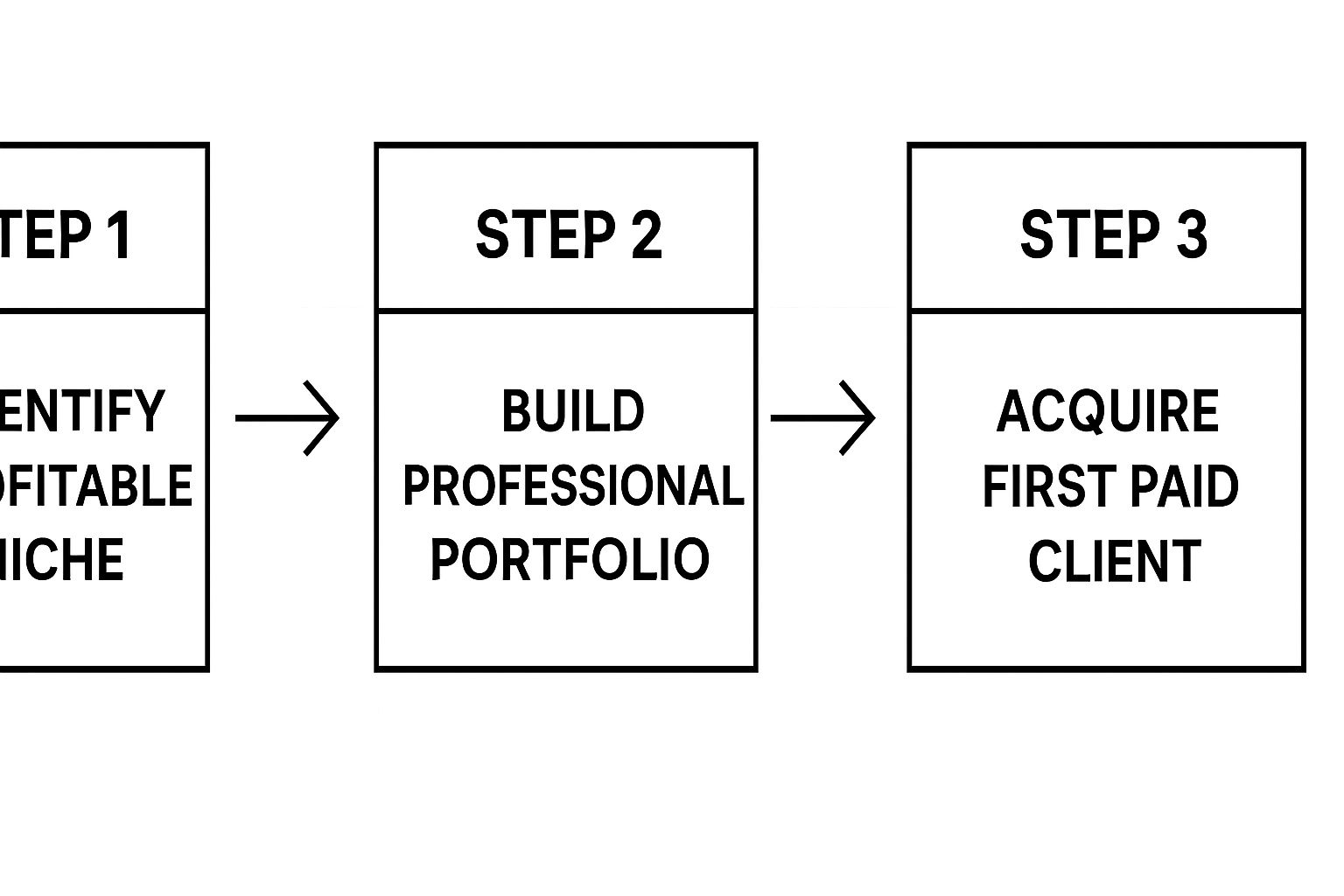
As you can see, success here isn't random. It's a logical progression: build your service, prove its value, and then connect with the people who need it.
The New Freelance Economy In India
India's freelance market is absolutely booming, driven by a new generation of skilled professionals who want flexibility and better earning potential. A recent report actually found that 60% of Indian freelancers are under 30 years old, which just shows the incredible energy fuelling this shift. This trend means more opportunities are opening up for anyone who can position themselves the right way.
The key is to stop thinking like a job-seeker waiting for an opportunity and start acting like a service provider creating your own. Your portfolio is your product, and your outreach is your marketing.
Core Pillars Of Freelance Success
To build a freelance business that actually thrives, you have to nail three critical areas. Getting these right will form the bedrock of your income growth:
- Skill Mastery: You have to offer a service that businesses are genuinely willing to pay good money for. This isn't just about learning a skill but becoming so good at it that you can deliver tangible results.
- Client Acquisition: You need a repeatable system for finding and landing paying clients. This could be through platforms, networking, or cold outreach—whatever works for you.
- Financial Management: Earning money is only half the battle. You absolutely must learn to manage your income, track your expenses, and plan for taxes to build sustainable wealth.
Knowing how to package your abilities into a sellable service is the first major hurdle. For a much deeper look into this, check out our guide on monetizing your skills in the gig economy.
This roadmap will walk you through each of these pillars, giving you a practical framework to hit your first major income goal.
Let's break down the journey into clear phases. Here's a quick overview of what the path from zero to your first ₹50k looks like.
Milestone Map From ₹0 to ₹50k/Month
This table gives you a bird's-eye view of the journey ahead. Think of it as your high-level map, showing you where to focus your energy at each stage to keep moving forward.
| Phase | Income Goal (Monthly) | Key Focus Areas | Primary Platforms |
|---|---|---|---|
| Phase 1: Foundation | ₹0 – ₹10,000 | Skill development, creating a basic portfolio, learning platform basics. | Fiverr, Upwork (for initial experience) |
| Phase 2: Traction | ₹10,000 – ₹25,000 | Refining your service, getting testimonials, building case studies, networking. | LinkedIn, Freelance Marketplaces |
| Phase 3: Growth | ₹25,000 – ₹50,000 | Increasing prices, pitching larger clients directly, building a personal brand. | LinkedIn, Direct Outreach, Personal Website |
| Phase 4: Scaling | ₹50,000+ | Retainer clients, building systems, potentially outsourcing work. | Referral Networks, Industry Connections |
Each phase builds on the last. You can't jump straight to scaling without first laying a solid foundation and getting some real-world traction. Now, let’s get into the specifics of Phase 1.
Building Your Foundation Without Any Clients

Here’s the classic trap every new freelancer falls into: you need a portfolio to get clients, but you need clients to build a portfolio. It’s a frustrating cycle, and frankly, it’s where most people get stuck and give up.
The secret? Break the cycle. Build your foundation before you even think about sending your first proposal.
In this early stage, your goal isn’t to earn money. It’s to build assets. Think of it like a chef prepping their ingredients before the dinner rush hits. You need to sharpen your skills, create concrete proof of your abilities, and set up a professional shopfront online. This groundwork is what separates freelancers who struggle for months from those who land their first client in weeks.
Choosing Your One High-Demand Skill
Trying to be a jack-of-all-trades is a surefire way to fail. Offering vague services like "digital marketing" just doesn't cut it anymore. The Indian market is crying out for specialists who can solve very specific business problems.
Here are a few skills that are consistently in high demand right now:
- Performance Marketing: Businesses want experts who can run profitable Facebook or Google Ads campaigns. They don’t just want clicks; they want tangible results like leads and sales.
- UI/UX Design: With more Indian startups going digital, the demand for intuitive and user-friendly app and website design is absolutely exploding.
- Technical Writing: Companies developing software or complex products need writers who can create clear, concise documentation, user guides, and help articles.
- Video Editing for Short-Form Content: Brands are desperate for editors who can chop up raw footage and turn it into engaging Instagram Reels and YouTube Shorts.
You don't need a fancy degree to learn these. Platforms like Coursera offer structured courses, while YouTube is a goldmine of free tutorials from industry pros. Pick one skill and dedicate a few solid weeks to mastering the fundamentals.
Creating Your Portfolio from Nothing
Once you've got a skill, you need to prove you can actually use it. A portfolio is just a collection of projects that shows off what you can do. Without paying clients, you have to get a bit creative and make your own projects. This isn't "fake work"—it's a powerful demonstration of your value.
A portfolio built on self-initiated projects shows more than just skill—it shows initiative, problem-solving ability, and a genuine passion for your craft. A client will often see this as a stronger signal than a simple paid gig.
Think about tangible projects you could realistically complete in a weekend. For instance:
- For a budding graphic designer: Redesign the logo and menu for your favourite local café. Put together a simple PDF explaining your design choices.
- For an aspiring content writer: Write a monster 5,000-word blog post on a topic you're obsessed with. Optimise it for search engines to show you understand SEO.
- For a new web developer: Build a simple one-page website for a hypothetical local business, like a yoga studio or a bookshop, using WordPress or a simple site builder.
The aim here is to have three solid project examples. Each one should clearly show a problem, your process for solving it, and the final result.
Setting Up Your Professional Shopfront
Your online profiles are your virtual storefront. Before you start pitching, they need to look sharp, professional, and trustworthy. This means getting your presence dialled in on the platforms where clients are actually looking for talent.
Start by creating polished profiles on LinkedIn and at least one major freelance marketplace like Upwork or Fiverr. This isn't just about filling in the blanks; it’s about marketing yourself strategically.
Key Profile Optimisation Tips
- Professional Headshot: Use a clear, friendly photo where you're looking at the camera. No selfies or party pictures, please.
- Benefit-Driven Headline: Don’t just list your job title. Explain the value you bring. Instead of "Content Writer," try "SEO Content Writer Helping SaaS Startups Boost Organic Traffic."
- Detailed 'About' Section: Use this space to tell a story. Talk about who you help, the problems you solve, and what makes you different. Weave in keywords relevant to your skill.
- Showcase Your Portfolio: Upload your self-started projects directly to your profile. For each one, add a short description explaining your thought process and the outcome.
This foundational work is non-negotiable. For a more detailed breakdown, our guide on https://moneymattr.com/how-to-start-freelancing-in-india/ offers a step-by-step checklist to make sure you're ready to attract high-quality clients from day one. By building your skills, creating a small but mighty portfolio, and polishing your online presence, you'll build the momentum you need to kickstart your freelancing journey.
How To Land Your First Paying Clients

Alright, you’ve put in the work. Your profile is sharp, your portfolio has a few solid pieces, and you're ready for the real deal: turning all that preparation into actual money. This is where the magic happens, and our goal is to get you into the ₹10,000 to ₹20,000 per month range.
Landing your first client is a mix of persistence and smart strategy. Anyone can spam a hundred copy-paste proposals and get nowhere. The trick is to be targeted, thoughtful, and genuinely interested in solving a client's specific problem. Think of it less like a numbers game and more like a strategy game.
The freelancing scene in India is buzzing. We saw a 46% jump in new freelancers in just one quarter. A huge chunk of them—about 46%—snagged their first gigs on online marketplaces like Upwork, Fiverr, and Freelancer.com. These platforms are clearly the place to start.
Mastering The Art Of The Proposal
Forget the old rules of job applications. A freelance proposal isn't a CV; it’s a direct sales pitch. Your one job is to convince a client that you not only understand their problem but are the best person to fix it.
A killer proposal on a platform like Upwork really only needs three things:
- The Hook: Start by hitting their pain point directly. Show them you actually read the project description instead of just skimming the title.
- The Solution: Give them a quick glimpse of how you’d tackle the project. This isn't a full-blown strategy document, just a taste of your expertise.
- The Proof: Link to the most relevant piece in your portfolio. If they need a blog post, show them the best blog post you’ve ever written.
Pro Tip: Always end with a clear call to action. Ditch the passive "I look forward to hearing from you." Instead, try something confident like, "Would you be free for a quick 15-minute chat next week to discuss how I can help you achieve [their specific goal]?"
Thinking Beyond Freelance Platforms
Marketplaces are a fantastic launchpad, but relying on them forever can stunt your growth. The real money and stability in freelancing come from finding direct clients. And for that, your professional network is your secret weapon.
LinkedIn is so much more than an online resume. It's a client-finding machine. Start connecting with people in your target industry. Don't just connect and ghost; share your portfolio work, write short posts about your skills, and actually engage with what potential clients are posting.
Here’s a real-world example:
Let's say you're a graphic designer and you just created a cool mock logo for a local cafe you love. Post it on LinkedIn and tag them!
"Had an amazing coffee at [Cafe Name] the other day and got inspired. Put together this quick logo concept imagining a fresh look for their brand! #GraphicDesign #Branding #LocalBusiness"
This kind of proactive, passion-driven work gets you noticed. It shows you're not just waiting for work to fall in your lap.
Setting Your Initial Pricing Strategy
Pricing. It's the number one thing that new freelancers stress about. The fear of quoting too high and scaring off a client is real, but let me tell you, undervaluing your work is a much bigger mistake in the long run.
Start by doing some market research. See what other freelancers with your skills and experience are charging. For your first couple of projects, you want to be competitive, but don't be the cheapest option. Your goal here isn't just to make money; it's to gain experience and—most importantly—get glowing testimonials.
A Simple Pricing Framework
| Pricing Model | Best For | Example |
|---|---|---|
| Project-Based | Projects with a clear, fixed scope (e.g., logo design, 5-page website). | "I'll design a complete brand logo package for ₹8,000." |
| Hourly Rate | Ongoing or unpredictable projects where the scope might shift. | "My hourly rate for website maintenance is ₹500/hour." |
For beginners, project-based pricing is usually the safer bet. It gives the client peace of mind knowing the final cost, and it takes the pressure off you to track every single minute.
The Power Of Over-Delivering And Testimonials
Your first few clients are pure gold. The money is great, but the social proof you get from a job well done is priceless. Always, always aim to over-deliver.
- Promised a blog post in five days? Get it to them in four.
- Designed one logo concept? Throw in a second variation for free.
These small gestures make a massive impression and build incredible goodwill. Once the project is done and the client is thrilled, don't be shy about asking for a review. A single fantastic testimonial can be the thing that convinces your next, higher-paying client to say yes. To get a head start, check out our guide with some killer cold outreach templates for Indian freelancers.
Scaling Your Income to The ₹50k Milestone
Alright, so you’ve got a steady stream of clients and money is coming in. That’s a huge win. But now you’re probably wondering, "How do I get to that next level without just working more hours?" Hitting the ₹50k/month milestone is less about finding more work and more about working smarter. It’s a strategic shift from being a person who completes tasks to becoming a high-value partner for your clients.
This stage is all about leverage. You'll use your portfolio, those glowing testimonials, and your growing expertise to justify higher prices and lock in more predictable income. It's time to stop chasing small, one-off gigs and start building a real, sustainable business.
Raising Your Rates With Confidence
Let’s be honest, asking for more money can be nerve-wracking. But if you’ve been consistently delivering great work, you’ve absolutely earned the right to charge more. The trick is to tie the increase to real, tangible value you provide.
So, when’s the right time? A good rule of thumb is after you’ve successfully wrapped up 3-5 projects or when you’re so busy that you’re starting to turn new work away.
Here’s how you can approach it with an existing client:
- Pick the Right Moment: The perfect time is right after you've knocked a project out of the park and delivered exceptional results.
- Frame It as a Mutual Benefit: Don't just announce a price hike. Explain that your new rates reflect your improved skills and allow you to dedicate more focused energy to their projects, leading to even better outcomes.
- Give Them a Heads-Up: Never surprise a client with a new rate. Give them at least a month's notice. You could say something like, "Just letting you know that starting next month, my rates for new projects will be updated to reflect my expanded services."
You’re not just charging for your hours anymore. You’re charging for the results, the reliability, and the peace of mind you bring to the table. Your price should reflect the value of the problem you’re solving for them.
Moving From Gigs to Retainers
One-off projects are fantastic for getting started, but they often lead to a "feast or famine" cycle. The real game-changer for hitting that ₹50k a month mark is securing clients on retainers. A retainer is simply an agreement where a client pays you a fixed fee each month for a specific set of deliverables or on-call availability.
This gives you a predictable base income, which makes managing your finances so much easier. The best candidates for retainers are usually clients you already have a fantastic relationship with and who have ongoing needs.
For example, a content writer might propose a retainer for four blog posts per month. A social media manager could offer a monthly package that covers content creation, scheduling, and community management. This shifts the dynamic from a one-time transaction to a long-term partnership.
The Power of Upselling and Cross-Selling
Your existing clients are your single biggest growth asset. They already trust you and know the quality of your work, which makes them far more open to new offers than a cold lead would be.
- Upselling: This is where you offer a client a more premium version of what they're already getting. If you're a web developer who built a basic website, you could upsell a monthly maintenance and security package.
- Cross-selling: This is about offering a related but different service. A graphic designer who just finished a logo could cross-sell a package of branded social media templates and banner ads.
Start thinking about what your clients will need next. When you anticipate their future challenges and offer solutions, you make yourself an indispensable part of their team. For those thinking even bigger, this is often the first step; check out our guide on how to scale from a solo freelancer to an agency owner for more advanced strategies.
India’s gig economy is set to explode, creating massive opportunities for growth. Projections by Persol India suggest the gig workforce could swell to between 60 and 90 million workers by 2030. While many start with lower earnings, there are significant opportunities for income growth through skill specialisation and smart business practices like the ones we've discussed. You can read more about India's flexible workforce trends at persolindia.com.
Managing Your Money Like a Business Owner

There’s nothing quite like the buzz of seeing that first payment hit your bank account. It’s the moment it all becomes real—proof that you can actually get paid for your skills. But this is also where a crucial mindset shift needs to happen. You're no longer just earning a salary; you're running a business, and that money is your revenue.
Treating your finances like an afterthought is the quickest way to turn a promising freelance career into a stressful grind. Let’s get you set up with the simple money habits that will carry you from ₹0 to ₹50k a month and beyond.
First Things First: Separate Your Freelance Finances
Before you even send your first invoice, do this one thing: open a separate bank account for your freelance business. Seriously, this is non-negotiable.
Mixing your business and personal money is a recipe for disaster. It makes it nearly impossible to figure out what you’re actually earning, what your business expenses are, and how much you owe in taxes. You’ll be drowning in a sea of transactions come tax time.
A dedicated current account (or even just a separate savings account to start) creates a clean line in the sand. All client payments go in, and all business expenses come out. This simple move immediately makes you feel more like a business owner and gives you a clear snapshot of your financial health at any given moment.
The Art of the Professional Invoice
An invoice isn't just a bill; it's a professional document that represents your brand. A sloppy, confusing invoice can leave a sour taste after a great project, while a clear, professional one builds trust and, most importantly, helps you get paid faster.
Make sure every invoice you send out has these key details:
- Your Details: Full name or business name, address, and PAN.
- Client's Details: Their name and business address.
- Invoice Info: A unique invoice number (e.g., #001, #002) and the issue date.
- Service Breakdown: A clear, itemised list of the services you provided. Don't be vague.
- The Numbers: The total amount due and a clear due date (e.g., "Due within 15 days").
- How to Pay: Your bank account number, IFSC code, and UPI ID.
You don't need fancy software right away. A clean template in Google Docs or Sheets is perfectly fine. The goal here is consistency and professionalism.
Think of your invoice as the final deliverable. A professional one reinforces your value and makes it easy for the client to pay you promptly. A messy one creates friction right at the finish line.
Demystifying GST for Indian Freelancers
As soon as money starts coming in, the dreaded topic of taxes pops up. For most new freelancers in India, GST is the big question mark. Let's clear it up.
GST (Goods and Services Tax) is a tax on services, and as a freelancer, you're a service provider. The most important number you need to know is the registration threshold.
Right now, you only have to register for GST if your total freelance income in a financial year crosses ₹20 lakhs. For someone on this roadmap aiming for ₹50k a month (which adds up to ₹6 lakhs a year), you’re comfortably below that mandatory limit. This means you don't need to register for GST or charge it to your clients. Simple.
There are some edge cases where registering voluntarily might make sense, particularly if you're dealing with a lot of international clients. To get the full picture, I'd recommend reading through a detailed guide on GST registration for freelancers in India to see what makes the most sense for your specific situation.
Paying Yourself and Saving for Taxes
That money from your client? It's not all yours to spend just yet. Smart freelancers treat their business account like a holding tank and pay themselves a "salary" from it. Most importantly, they start setting aside money for income tax from day one.
A super simple and effective way to manage this is the 50/30/20 rule for freelancers:
- 50% for You: Move this portion to your personal account. This is your salary to cover all your living expenses.
- 30% for Taxes: Leave this in your business account. Don't touch it. This is your tax fund.
- 20% for Business: Keep this for business expenses, reinvesting in new tools or courses, or just as a cash buffer for slow months.
This discipline saves you from the massive shock of a huge tax bill at the end of the year. By putting money aside from every single payment, you'll always be ready.
Got Questions About Freelancing in India? We Have Answers
As you start mapping out your freelance journey, you're bound to run into some questions. That's completely normal. Stepping into the world of self-employment in India for the first time means getting your head around payments, taxes, and the right strategies to grow.
Getting clear, straightforward answers is what gives you the confidence to build your business. So, let’s tackle some of the most common questions that pop up for new freelancers.
Do I Really Need to Worry About GST Registration Right Now?
For anyone just starting out and aiming for that initial ₹0 to ₹50k/month goal, the answer is almost always a simple no.
GST registration only becomes mandatory once your total annual freelance income crosses the ₹20 lakhs threshold (or ₹10 lakhs in special category states). This is a huge relief because it means you can pour all your energy into honing your skills and landing those first few clients without getting tangled up in GST compliance.
There's a small catch if you work with international clients. Some freelancers register for GST voluntarily to claim certain tax benefits, but it's definitely not a requirement when you're just getting started.
Key Takeaway: Don't let GST confusion paralyse you. As long as your yearly turnover is well under ₹20 lakhs, you're in the clear. You can always revisit this once your income starts climbing.
Which Freelance Skills Are Actually in Demand in India?
While trends come and go, a few skill sets are always in demand in the Indian market. The trick isn't just to chase what's hot right now, but to find that sweet spot where high demand meets what you actually enjoy doing.
Here are some skills that businesses are consistently willing to pay for:
- Digital Marketing: SEO, social media management, and paid advertising are evergreen. Every business is fighting for eyeballs online, and they need experts to help them win.
- Web and App Development: If you're skilled in technologies like React, Python, or Flutter, you're in a great position. Companies always need developers to build and maintain their digital products.
- Content and Copywriting: Great writers are worth their weight in gold. Brands desperately need people who can craft engaging blog posts, sharp website copy, and compelling video scripts.
- Graphic and UI/UX Design: With user experience being more critical than ever, designers who can create interfaces that are both beautiful and easy to use are highly sought after.
My advice? Pick a skill you're genuinely passionate about. That passion is what will drive you to become a real expert, and expertise is what allows you to command much higher rates down the line.
How Do I Legally Handle Payments From International Clients?
Getting paid by clients from abroad is one of the most exciting parts of freelancing, and thankfully, it’s pretty straightforward. You just need to follow a few key steps to stay on the right side of Indian regulations like the Foreign Exchange Management Act (FEMA).
The easiest and safest route is to use established payment gateways. Platforms like PayPal or Payoneer are built for these kinds of transactions and take care of most of the compliance headaches for you. A direct bank wire transfer is also a solid option.
Whenever you receive foreign currency, your bank will issue a Foreign Inward Remittance Certificate (FIRC). This document is gold. It's your official proof that the money came from overseas and is absolutely essential when you file your taxes. Always, always keep meticulous records of your international invoices and the FIRC that corresponds to each one.
Should I Be a Generalist or Specialise in a Niche?
When you’re just starting, the answer couldn't be clearer: specialise.
Trying to be a jack-of-all-trades is one of the most common mistakes new freelancers make. It makes it incredibly difficult to stand out from the crowd. Think about it: when a client has a very specific, urgent problem, they don’t look for a generalist. They look for an expert who lives and breathes that problem.
For example, instead of just calling yourself a "writer," position yourself as a "B2B SaaS blogger who helps fintech startups increase organic traffic." See the difference? This kind of specific positioning immediately makes you the obvious choice for a very specific type of client. It also helps you build a killer, highly relevant portfolio much, much faster.
Once you’ve built a strong reputation and a steady flow of income in your niche, then you can think about strategically adding related services to what you offer.
At Money Mattr, we provide the insights and tools you need to manage and grow your freelance finances with confidence. Explore more resources and build your financial future at https://moneymattr.com.