


Getting your first client in 7 days through cold outreach is absolutely doable, especially for freelancers in India. The trick isn't magic; it's a focused strategy. You'll spend two days on deep research, three days sending out sharp, personalised emails, and the last two days on smart, value-packed follow-ups. This system turns what feels like a huge challenge into a clear, week-long mission.
Your 7-Day Roadmap to Your First Paying Client
Landing that first client isn't about spamming hundreds of generic emails and crossing your fingers. That's a rookie mistake. It’s a calculated process that shows you respect your prospect's time and can offer real value from the very first hello.
In the crowded Indian market, building trust quickly is everything. This roadmap will help you shift your mindset from a job-seeker to a strategic problem-solver. Instead of just asking for work, your goal is to prove you understand their business and have a specific solution for a problem they're facing right now. This is how you cut through the noise and get noticed.
Building Momentum from Day One
The first 48 hours are all about prep work. You're not just looking for any company; you're hunting for businesses that are a perfect fit for your skills.
- Define Your Ideal Client: Who do you really want to work with? A tech startup in Bengaluru? A D2C brand in Mumbai? Getting specific makes your search a hundred times more effective.
- Find Their Problem: Once you have a target, dig around and find a problem you can solve. Is their website copy a bit flat? Is their Instagram feed all over the place? This is your "in."
- Find the Decision-Maker: Use LinkedIn to pinpoint the right person. This could be a founder, the head of marketing, or an HR manager, depending on the company's size.
This initial legwork is what makes your outreach feel relevant and personal, massively boosting your chances of getting a reply. You stop being just another freelancer in their inbox and become a specialist with a ready-made solution.
While this direct outreach method is powerful, it's also smart to explore other avenues like the top best freelancing sites in India to earn money to keep your options open.
The infographic below breaks down this seven-day journey, showing you how to go from building a target list to officially landing that first paying gig.
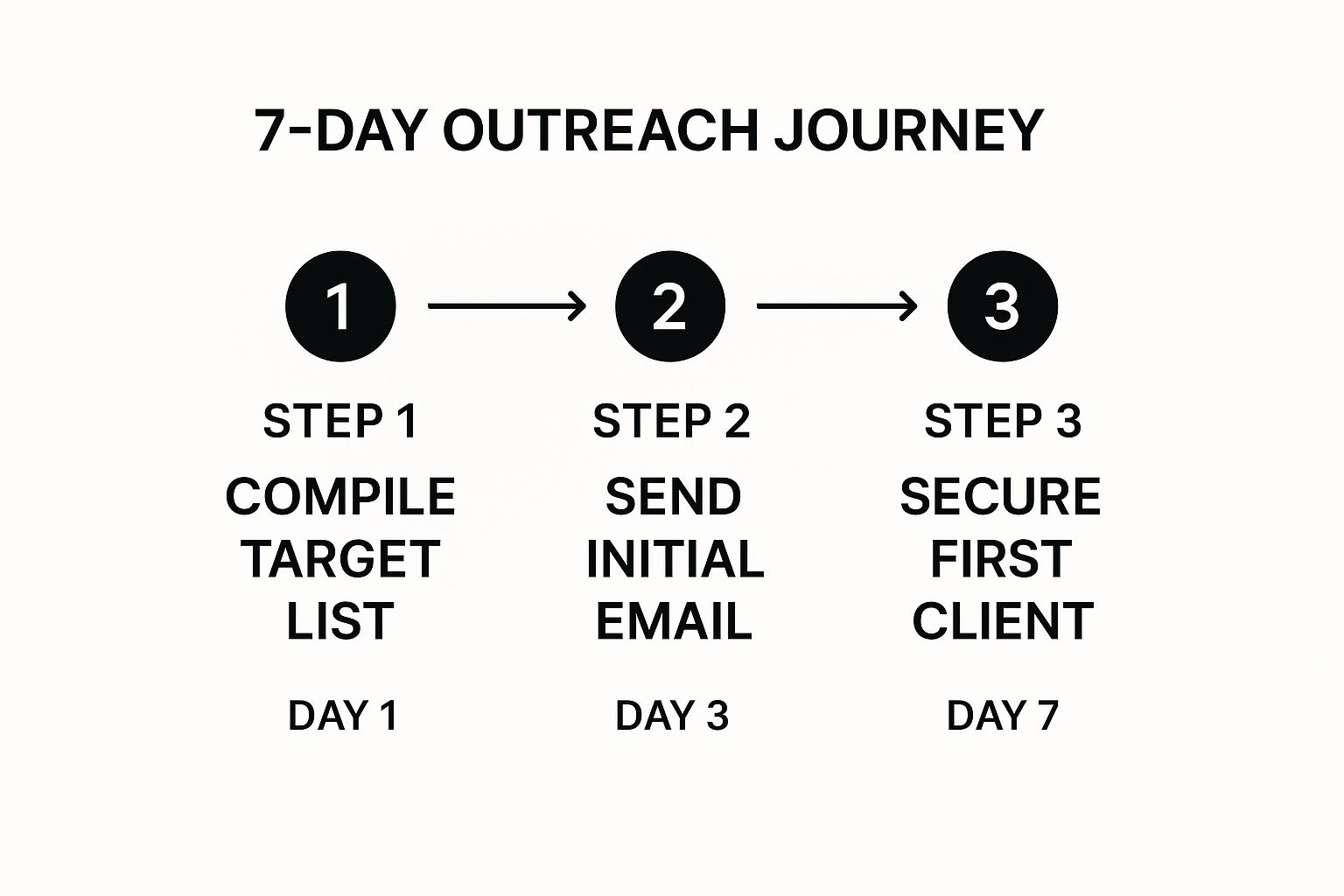
As you can see, the plan is front-loaded with research. This isn't about last-minute panic; it's about thoughtful, consistent communication.
To make this even clearer, here's a day-by-day blueprint you can follow. This table breaks down the entire week into manageable, actionable steps.
The 7-Day Client Acquisition Blueprint
| Day | Primary Goal | Key Actions | Expected Outcome |
|---|---|---|---|
| 1 | Research & List Building | Define Ideal Client Profile (ICP). Find 20-30 companies that match your criteria. | A curated list of high-potential leads. |
| 2 | Problem Identification | Analyse each company's online presence. Identify a specific, solvable problem for at least 10 of them. | A smaller, hyper-targeted list with a clear "reason to contact." |
| 3 | Craft & Send First Batch | Write and send 3-4 highly personalised cold emails. Focus on the problem you found. | Initial outreach is live. Expect a 10-15% initial response rate. |
| 4 | Send Second Batch & Track | Send another 3-4 personalised emails. Use a spreadsheet to track who you've contacted and when. | Momentum builds. Keep tracking opens and clicks. |
| 5 | Send Final Batch | Send the last batch of initial emails. Your pipeline of potential clients is now active. | All initial emails have been sent. |
| 6 | First Follow-Up | Send a gentle, value-add follow-up to everyone who hasn't replied from Day 3. No "just checking in." | Re-engage prospects and show persistence. |
| 7 | Second Follow-Up & Review | Follow up with the Day 4 batch. Review your week, note what worked, and prepare for replies. | Conversations are starting, and you have a clear plan for next week. |
This table isn't just a schedule; it's a system designed to build momentum and keep you focused. Stick to it, and you’ll be surprised at the progress you can make in just one week.
The core idea of this 7-day plan is simple: preparation and personalisation are more powerful than volume. A dozen well-researched emails will always outperform a hundred generic templates.
By following this structure, you're not just hoping to get lucky once. You're building a repeatable system for getting clients—the foundation for a sustainable freelance career built on strategy, not chance.
Building a Client-Ready Freelancer Profile

Before your first cold email even lands in an inbox, your prospect will likely search for you. What they find needs to instantly build trust and position you as a credible expert, not just another freelancer looking for work. Think of your online presence as your digital handshake.
Your LinkedIn profile and portfolio are silent salespeople working for you 24/7. They need to shout your value from the rooftops, clearly and professionally. For an Indian business owner, this means seeing a profile that understands the local market and speaks their language, both literally and figuratively.
Optimise Your LinkedIn Headline and Bio
Your LinkedIn headline is prime real estate. Please, move beyond a simple job title like "Content Writer." It tells people what you do, but not what you achieve.
Instead, craft a headline that communicates the result you deliver. For example, "Content Strategist Helping Indian D2C Brands Increase Organic Traffic." This immediately tells a potential client who you help and what you help them with. It’s specific and powerful.
Your bio should continue this story. Don't just list your skills—that's what the skills section is for. Frame them around the problems you solve for clients.
- The Problem: "Many Indian startups struggle to create blog content that ranks on Google."
- Your Solution: "I create SEO-driven articles that help startups in India capture top search positions, attracting qualified leads without paid ads."
This problem-solution format makes your value tangible. It shows you've actually thought about their specific challenges, not just your own services.
A strong profile doesn’t just say what you do; it shows you understand who you do it for. This is the difference between being a generalist and a sought-after specialist in the Indian freelance market.
Turn Projects into Compelling Case Studies
"But I don't have any client work yet!" I hear you. No problem. Use your personal projects.
The key is to frame them as professional case studies that showcase your process and results. This is a critical step for anyone learning how to start freelancing in India.
For instance, a graphic designer could redesign the logo for a popular local brand and create a presentation explaining the strategic choices behind the new design. A writer could develop a sample content strategy for a FinTech startup in Mumbai, complete with keyword research and topic ideas.
Document your entire process:
- The Challenge: Clearly define the problem you set out to solve. Why did you pick this project?
- The Process: Detail the steps you took, from research to execution. Show your thinking.
- The Outcome: Showcase the final product and explain how it solves the initial challenge. What was the impact?
This approach demonstrates your skills in a real-world context, proving your capabilities even without a formal client history. It shows initiative and a professional mindset—exactly what a business owner wants to see. This groundwork is what makes your cold outreach templates for Indians so much more effective when you finally hit "send."
Crafting Cold Emails That Actually Get Opened
Your perfectly polished freelancer profile might get you noticed, but it’s your cold email that actually starts a conversation. Think of these messages less like emails and more like a strategic business proposal, squeezed into just a few powerful sentences. The real goal here isn't just to get an open, but to earn a reply.
This means you have to ditch the generic, copy-paste scripts for good. To succeed in the Indian market, you need a smart blend of professionalism, genuine respect for the other person’s time, and a direct showcase of value. Your email has to prove you’ve done your homework and aren’t just another name in a mass email blast. It’s all about positioning yourself as a problem-solver from the very first line.
The Anatomy of a Reply-Worthy Email
Every single email you fire off should be built on a simple, effective framework. It's designed to respect the recipient's time while making your value crystal clear. This structure is the foundation for the templates we’ll get into later.
Here’s how to break it down:
- The Hook (Personalised Opening): Start with something that immediately shows you’re not a robot. Mention a recent company milestone you saw on LinkedIn, a blog post they wrote that you genuinely enjoyed, or maybe a mutual connection.
- The Pitch (Clear Value): This is where you connect your service directly to a challenge they might be facing. Keep it short, sharp, and focused on the benefit to them, not a long story about yourself.
- The Ask (Low-Friction CTA): End with a simple, easy-to-answer question. Don't ask for a 30-minute call right away—that’s a huge commitment. Instead, ask for their thoughts on your idea or simply if they’re the right person to talk to.
This approach flips your message from a pushy sales pitch into a helpful suggestion, which dramatically boosts your chances of getting a response.
Subject Lines That Cut Through the Noise
Your subject line is the gatekeeper. If it screams "sales pitch" or "spam," your carefully crafted email is dead on arrival. The best subject lines are intriguing, specific, and professional.
Forget clickbait or anything too casual. Instead, try these proven approaches that feel more human:
- Reference a Connection: "Question from a fellow [Industry] professional"
- Offer a Specific Idea: "Idea for [Company Name]'s blog strategy"
- Keep It Simple and Direct: "Quick question about your content"
These are designed to feel personal and relevant, sparking just enough curiosity to earn that all-important open.
Let’s be real: cold outreach is a numbers game. Globally, about 95% of cold emails fail to get a reply, with average response rates hovering between a slim 1% and 5%. However, for Indian freelancers on a 7-day mission to land their first client, highly personalised campaigns that leverage social proof have been shown to hit reply rates as high as 18%. You can dig into more B2B cold email statistics over at martal.ca.
Ensuring Your Emails Land in the Inbox
Even the most brilliant email is useless if it winds up in the spam folder. Getting the technical side right is non-negotiable. Before you send a single email, make sure your domain is properly authenticated by setting up records like SPF, DKIM, and DMARC for your professional email address.
These technical steps are like a passport for your emails, signalling to providers like Google and Microsoft that you're a legitimate sender. It’s a one-time setup that massively improves your deliverability, making sure your messages actually reach the primary inbox where they can be seen and acted upon.
And if you need a hand crafting compelling email copy, our guide on the best AI content writing tools can help you speed up the process.
Using LinkedIn for Smarter Outreach

Email is your workhorse, but if that’s where your outreach stops, you're leaving money on the table. A multi-channel approach that layers LinkedIn on top of your email game is what really separates the pros from the beginners.
In India, LinkedIn isn't just a digital CV. It's a buzzing professional network where connections are made, relationships are built, and deals get closed every single day.
But using LinkedIn smartly means ditching the generic "I'd like to connect with you on LinkedIn" message. Seriously. That default request is the fastest way to get your invitation ignored. The goal is to start a real conversation and position yourself as a helpful expert, not just another freelancer asking for work.
The Warm-Up Before the Pitch
Before you even dream of hitting that 'Connect' button, you need to get on your prospect's radar. This is all about building a little familiarity.
Spend a few days engaging with their content. Like their posts, drop an insightful comment, or share something they’ve written with your own network. It’s a simple strategy, but it works wonders.
This little bit of engagement accomplishes two things:
- It proves you’re actually paying attention and are genuinely interested in what they do.
- Your name and profile picture start looking familiar. When your connection request finally lands, it’s not from a total stranger.
This warm-up phase is your secret weapon. It turns a cold, impersonal interaction into a much warmer one, massively boosting your odds of getting a positive reply.
Your objective isn't to be a salesperson; it's to be a valuable connection. Let your LinkedIn profile—packed with social proof and case studies—do the selling for you. Your direct outreach is for building the human relationship that ultimately leads to business.
Crafting Connection Requests That Get Accepted
That connection request is your first direct point of contact. Make it count. You absolutely must add a personal note that explains why you want to connect.
Here are a few templates I’ve seen work time and time again. Feel free to adapt them:
- For a Mutual Group/Connection: "Hi [Name], I saw your insightful comment in the [Group Name] about [Topic]. I’d love to connect and follow your work."
- For a Company Achievement: "Hi [Name], congratulations to the team at [Company Name] on the recent [Achievement/Launch]. Really impressed with your work in the space and would love to connect."
- For a Shared Interest: "Hi [Name], I noticed we both follow [Influencer Name] and really enjoyed your recent post on [Topic]. It would be great to connect with like-minded professionals."
Once they accept, your next move is a direct message that offers value right away. For more ideas on how to showcase your expertise, check out our guide on monetizing your skills in the gig economy.
Mastering the Art of the Follow-Up
Just sending one cold email and then sitting back to wait? That’s where most freelancers stumble.
The hard truth is your first message often lands in a jam-packed inbox, gets a quick glance, and is just as quickly forgotten. The real magic in landing your first client in 7 days happens in the follow-up. It's an art that needs just the right mix of persistence and professionalism, especially when you're navigating Indian business culture.
Giving up after one try is like walking out of a conversation before it's even started. Your prospect might have been interested but then got pulled into a meeting or sidetracked by something urgent. A smart follow-up sequence pushes your name right back to the top of their inbox, reminding them of the value you offered and proving you’re serious and organised.
The Value-Add Follow-Up Sequence
Forget those lazy "just checking in" emails. That's a surefire way to get ignored. Every single follow-up you send needs to deliver fresh, standalone value. Your goal here is to be helpful, not a pest. Think of it as a mini-campaign designed to build a bit of trust and show off your expertise over a few days.
Here’s a simple but seriously effective 3-step sequence:
- Follow-Up 1 (2 days after the first email): The Gentle Nudge. This is just a polite reminder. Briefly reference your original email and maybe offer a slightly different angle or a quick, useful resource related to their business.
- Follow-Up 2 (4 days after the first email): The Fresh Insight. Now you're adding pure value. Share a link to a relevant article, a surprising statistic about their industry, or even a link to one of your case studies. This message should be all about them, not you.
- Follow-Up 3 (7 days after the first email): The Breakup Email. This is your final, professional sign-off. Let them know you won't be following up again but you're around if they need you down the line. It's courteous, closes the loop, and you'd be surprised how often it triggers a reply.
This structured approach shows you're methodical and respect their time. It also keeps you on their radar without becoming an annoyance.
Navigating Professional Etiquette in India
Timing and tone are everything. Don't even think about sending follow-ups on weekends or late at night. Stick to professional hours, usually between 10 AM and 5 PM on weekdays. When it comes to your language, it’s always better to start off a bit more formal until they reply with a more casual tone.
Patience is a big one, too. Decision-making can sometimes be a slower process, so don’t get disheartened if you don't hear back right away. Your persistent, value-first approach will eventually cut through the noise.
The fortune is in the follow-up, but only when it’s done right. Each message is a chance to prove your value, show you understand their business, and start building a relationship—even before they’ve hit reply.
It's also important to remember that while cold outreach is a powerful tool, you have to do it the right way in India. Cold emailing isn't illegal, but there are strict rules about unsolicited messages. Always give people a clear way to unsubscribe. Considering most salespeople give up after just one email, adding a few thoughtful follow-ups can boost engagement by 50% or more.
Ultimately, turning a 'no response' into a real conversation is all about strategic persistence. Once that chat starts, you need to be ready. You can learn more about how to negotiate payment terms as a freelancer in our detailed guide.
Common Questions on Indian Client Outreach

Let’s be honest, diving into cold outreach can feel a bit daunting. A lot of questions pop up, and sometimes, those little uncertainties are all that’s holding you back from landing that first client in 7 days.
I've been there. So, let’s clear the air and tackle some of the most common questions Indian freelancers have. Think of this as a quick chat to get you past those initial roadblocks and on your way to sending emails with confidence.
What Is the Best Time to Send Cold Emails in India?
Timing isn't everything, but it definitely helps get your email opened. While there's no single "magic hour" that works for everyone, a good rule of thumb is to aim for mid-week.
Data usually points to Tuesdays and Thursdays as the sweet spots.
Try sending your emails mid-morning, around 10–11 AM, or mid-afternoon, between 2–3 PM. This way, you’re not getting lost in the Monday morning chaos or the Friday afternoon wind-down. But remember, the real golden rule is to test it out. A startup founder in Bengaluru will have a completely different inbox routine than a marketing head in Delhi.
Should I Mention My Price in the First Email?
In a word: no. Absolutely not. Your first email has one job, and one job only—to get a conversation started and show that you can bring value to their business.
When you lead with your price, you turn yourself into just another expense before you’ve even had a chance to position yourself as a solution.
First, focus on their problems. Understand what they’re struggling with. Once you’ve had a proper chat and can offer a solution that feels like it was made just for them, discussing the price becomes a much easier, more natural conversation.
Your goal isn't to be the cheapest option; it's to be the best option. Prove your value first, and the price will be a much easier conversation later on.
What if I Have No Client Work for My Portfolio?
This is the classic chicken-and-egg problem every new freelancer faces, but it's easier to solve than you think. If you don't have client work, create your own. Make up your own projects!
These personal or conceptual projects become powerful case studies that do the talking for you.
- For a web designer: Pick a popular Indian brand and give their website a redesign. Then, write a blog post walking through your strategic choices and design thinking.
- For a writer: Create a sample content strategy for a local startup you admire. Include some keyword research and a few killer topic ideas.
The key is to frame these like real projects. Document the "problem," your process, and the final outcome. It shows you’ve got initiative, and it’s a tangible way to prove you know your stuff.
At Money Mattr, we provide the financial knowledge and tools you need to build a successful freelance business. Learn how to manage your income, set your rates, and achieve financial independence. Explore our resources at https://moneymattr.com.

Ayush Gupta is an entrepreneur and SEO consultant with over a decade of experience helping businesses grow. As the founder of Visibility Ventures, he combines technical expertise with practical financial knowledge to guide readers through credit cards, investments, and tax optimization. He holds certifications in Entrepreneurship and Business Laws from NUJS Kolkata and regularly advises companies on digital growth strategies.