

The million-rupee question for every freelancer in India is pretty simple: when do I actually need to register for GST?
Let’s cut to the chase. You must register for GST if your total annual freelance income crosses ₹20 lakh (or ₹10 lakh in certain states). This isn’t just a suggestion; it’s a legal requirement to stay compliant and steer clear of some hefty penalties.
Decoding the GST Threshold for Freelancers

The Goods and Services Tax can feel like a maze, but the rules for us freelancers boil down to a clear financial benchmark. The government has set a specific income limit, and once you cross it, registration is no longer optional.
Understanding "Aggregate Turnover"
Here’s where many freelancers trip up. They only count income from their Indian clients. But the taxman looks at your 'aggregate turnover', a term that’s crucial to understand. This includes all your earnings under your PAN—taxable services, exempt services, and yes, even your export income.
Let's take a real-world example. Imagine Priya, a freelance web developer. Her income for the financial year looks like this:
- ₹15 lakh from clients based in India.
- ₹7 lakh from a client in the USA.
Priya’s aggregate turnover is ₹22 lakh. Even though her domestic income is below the threshold, her total earnings have shot past the ₹20 lakh mark. This makes GST registration mandatory for her. It’s a classic oversight, assuming international income exists in a separate bubble from Indian GST.
For a quick reference, here’s how the thresholds are structured across India.
GST Registration Thresholds for Freelancers
| Category | Annual Turnover Threshold | Applicable For |
|---|---|---|
| Normal Category States/UTs | Above ₹20 Lakh | Most states and union territories in India. |
| Special Category States | Above ₹10 Lakh | Arunachal Pradesh, Manipur, Meghalaya, Mizoram, Nagaland, Puducherry, Sikkim, Telangana, Tripura, and Uttarakhand. |
Once a freelancer like Priya hits that ₹22 lakh mark, she has to register for GST. From that point on, she’ll need to add 18% GST to her invoices, collect it, and file regular returns. It’s a shift in how you manage your finances, but it's non-negotiable once you cross the line.
Key Takeaway: Your total freelance income from all sources—whether a client in Bengaluru or Berlin—counts towards the GST threshold. Don't fall into the trap of only looking at your Indian earnings.
When Voluntary Registration Makes Sense
But what if your income is comfortably below the ₹20 lakh mark? You might still want to consider registering for GST voluntarily. Why?
Many large corporate clients actually prefer working with GST-registered freelancers. It allows them to claim Input Tax Credit (ITC) on the services they pay for, which is a big deal for their own accounting.
Having a GSTIN (GST Identification Number) also adds a layer of professionalism and credibility to your freelance practice. It signals that you’re operating as a serious business entity, which can open doors to bigger, more lucrative projects. It’s a strategic move if you’re thinking about scaling up from a freelancer to a registered business owner. For anyone with long-term growth in mind, voluntary registration is definitely worth considering.
Gathering Your Documents for a Smooth Application

Let's be honest, a successful GST registration starts long before you even open the government portal. The real secret? Preparation.
Getting all your documents scanned, correctly formatted, and ready to go will save you from a world of frustration. Think of it like organising your toolkit before a big project—it makes the actual job much smoother.
The portal requires a few core documents to verify who you are, where you live, and your banking details. These are non-negotiable, and the system is pretty picky about getting them right.
Your Core Document Checklist
Before you even think about filling out the form, get clear, scanned copies of these essentials. Trust me, this single step is the difference between a quick 10-minute upload and a day-long headache.
- PAN Card: Your Permanent Account Number is the absolute foundation for any tax-related process in India. No getting around this one.
- Aadhaar Card: This is crucial for identity verification, and it's usually tied into the e-KYC process to make things faster.
- Photograph: You'll need a recent, passport-style photo in a digital format (JPEG usually works best).
- Bank Account Details: Proof of your bank account is a must. A scanned copy of a cancelled cheque or the first page of your passbook will do the trick. Just make sure it clearly shows your name, account number, and IFSC code.
Solving the "Place of Business" Puzzle
This is where most freelancers get stuck. How do you prove a "principal place of business" when you're working from your living room or a rented flat? The GST portal needs a valid address proof, and that can get tricky if the property isn’t in your name.
Luckily, the solution is pretty simple. You can use utility bills like an electricity or gas bill, or even a property tax receipt.
Pro Tip: If you're working from a property owned by a family member (like your parents) or you're renting, you absolutely must upload a No Objection Certificate (NOC). This is just a simple letter signed by the property owner stating they’re okay with you using the address for your freelance work. A recent utility bill paired with an NOC is the gold-standard fix for any home-based freelancer.
Getting Your Files Portal-Ready
The GST portal is notoriously strict about file uploads. Ignoring the rules is one of the most common—and easily avoidable—mistakes.
Every single document you upload needs to fit specific size and format requirements.
- File Format: Stick to JPEG or PDF. The system won’t accept anything else.
- File Size: Keep each file under 1 MB.
Before you start, just take a few minutes to check your scanned files. If a PDF is too big, use a free online compressor to shrink it down without losing quality. Getting these technical details sorted beforehand means you won’t have the system timing out or rejecting your files halfway through the process.
How to Navigate the GST Registration Portal
Alright, let's tackle the official GST portal. At first glance, it can look a bit intimidating—a wall of government text and forms. But trust me, once you know the lay of the land, it's a straightforward process. We're going to walk through it together, breaking it down so you can get your GST registration for freelancers done without any headaches.
Think of yourself as a freelance designer ready to make it official. The very first thing you need is a Temporary Reference Number (TRN). This is basically your entry ticket to the main event: the application form, GST REG-01.
To get your TRN, you’ll head over to the official GST website and find the 'New Registration' option under the Services tab. The portal will ask for your PAN, mobile number, and email address. It then shoots OTPs to both for a quick verification. Once that's done, your TRN is generated and sent your way. Keep this number safe—you'll need it to log back in and pick up where you left off.
Filling Out Your Application Form GST REG-01
With your TRN in hand, you can log back in and get to the main application. The form is split into several tabs, each asking for specific details about you and your freelancing gig. This is where having all your documents organised beforehand really pays off. The portal sessions are notorious for timing out, and you don't want to be scrambling for a document while the clock is ticking.
One of the first things you'll do is fill in your business details. It’s simpler than it sounds.
- Business Name: Just use your legal name, exactly as it appears on your PAN card. No need for a fancy business name unless you've registered one.
- Constitution of Business: As a solo freelancer, you’ll select ‘Proprietorship’. This is the standard for individual operators.
- Reason for Registration: If you're registering because your income crossed the threshold, you'll choose ‘Crossing the Threshold’.
This flow chart gives you a bird's-eye view of the entire journey, from making the decision to register to finally getting your GSTIN.
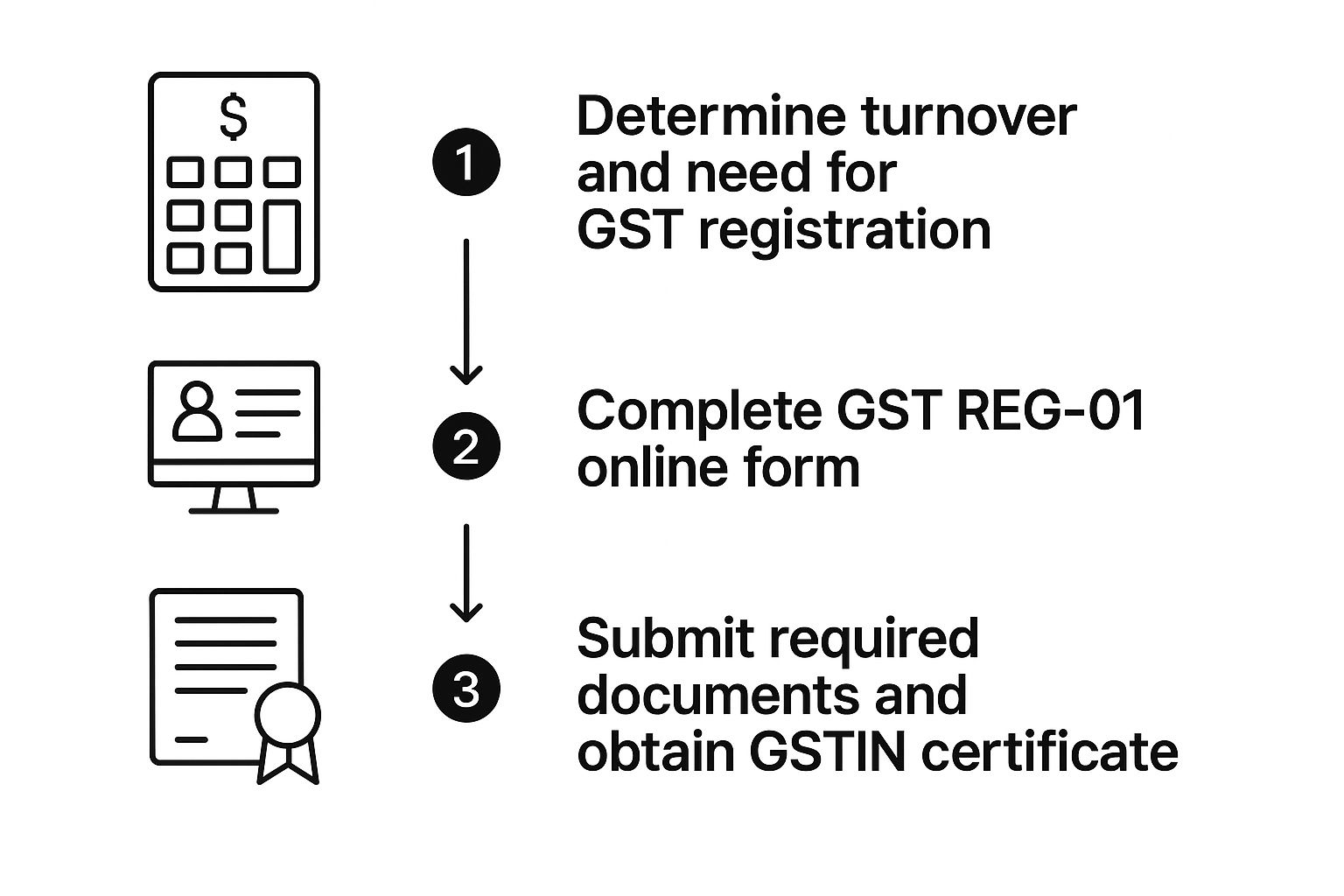
As you can see, it's a logical sequence, not a chaotic mess. Next up, you'll enter your business address details and upload the proof you prepared—like that electricity bill and the NOC we covered earlier.
Finding Your Service Code and Finalising Submission
The HSN/SAC code section trips up a lot of freelancers. Don't let it confuse you. For services, we use SACs (Services Accounting Codes). You don't need to memorise some gigantic codebook.
For the vast majority of freelance services—writing, design, consulting, software development, you name it—the magic number is 9983. This code covers most professional, technical, and business services. Just search for it in the portal, select it, and you're good to go.
After you've entered your bank details, it’s time for the final step: verification. This is handled through Aadhaar authentication. You'll get a link to verify your identity using an OTP sent to the mobile number linked to your Aadhaar. This is a critical step that really speeds things up.
Expert Tip: Don't delay the Aadhaar authentication. Jump on it as soon as you get the link. Applications that are Aadhaar-authenticated are often processed in just 3-7 working days. If you skip it, you might be flagged for a physical verification, which can drag the process out for weeks.
Once you've submitted everything and authenticated your Aadhaar, you’ll receive an Application Reference Number (ARN). You can use this number to track your application status right on the portal.
See? With a bit of prep, the GST portal becomes just another task on your to-do list, not some insurmountable beast.
Managing GST for International Clients and Exports

Landing international clients is a massive win for any freelancer. But it almost always brings up the same question: what do I do about GST for clients in the US, UK, or Australia?
The good news is that the Indian government actually wants you to work with global clients. The tax system is set up to encourage it.
This brings us to the concept of a "zero-rated supply". Put simply, when you export your services, the government gives it priority. This means you don't have to charge the usual 18% GST on your invoices. It's a huge relief because it keeps your pricing competitive on the world stage.
To make this official, you need to file something called a Letter of Undertaking (LUT) with the GST department. Think of the LUT as your formal declaration that you're an exporter and will follow the rules. It's a straightforward, one-time online process that covers you for the entire financial year.
The Power of a Letter of Undertaking (LUT)
Honestly, filing an LUT on the GST portal is a game-changer. It's what allows you to send invoices for your services to overseas clients without collecting a single rupee in GST.
This is critical. Let's say you're a web developer in Bengaluru working with a startup in San Francisco. Without an LUT, you'd technically need to add 18% GST to your invoice, making you way more expensive than a local American developer.
With a valid LUT, you just bill your client for the agreed amount. No tax, no fuss. It keeps things simple and makes your services far more attractive. Filing the LUT is done entirely online using Form GST RFD-11 and it's usually approved pretty quickly.
Key Insight: The LUT isn't just a piece of bureaucratic paperwork; it's a strategic business tool. It puts Indian freelancers on a level playing field with global talent by removing the awkwardness of charging local taxes to foreign clients.
Zero-Rated Supply vs. Nil-Rated Supply
Now, this is where things can get a bit confusing, but it's an important distinction to grasp. Don't mix up a zero-rated supply (like your exports) with a nil-rated or exempt supply. While they both mean you don't charge the client GST, the impact on your finances is completely different.
- Zero-Rated Supply: You don't charge GST on your invoice, but you can still claim back the GST you paid on your business expenses. This is called Input Tax Credit (ITC). Think software subscriptions, a new laptop, or your internet bill.
- Exempt/Nil-Rated Supply: You don't charge GST, but you also cannot claim any ITC on your business expenses.
This difference is massive for your bottom line.
For freelancers with international clients, being a zero-rated supply is the best-case scenario. You stay competitive globally and you get to recover the GST you've already paid on your operating costs. This directly boosts your profit margin.
There is one key condition, though: the payment from your client must come through in a convertible foreign currency. This is non-negotiable for your service to be officially considered an export. Navigating these payment channels can be a topic in itself, and if you're curious about modern options, check out our guide on receiving cryptocurrency payments as an Indian freelancer.
Your Ongoing GST Compliance Checklist
Getting your GSTIN is a huge step, but honestly, that’s where the real work begins. Think of it less as crossing a finish line and more as starting a new, crucial habit for your freelance business. Now, your focus has to shift to the ongoing tasks that keep you on the right side of the tax authorities.
The first and most important habit is issuing proper, GST-compliant invoices for every single project. This isn't just about sending a bill; it's about creating a legal record. Your invoice needs to clearly state your GSTIN, the client's GSTIN (if they have one), the correct SAC code for your services, and a clear breakdown of the taxable value and the 18% GST you've charged.
The Rhythm of Filing Your Returns
For most freelancers just starting out, the government has a simplified process called the QRMP (Quarterly Return Monthly Payment) scheme. This is an absolute lifesaver if your annual turnover is under ₹5 crores.
Under the QRMP scheme, you only file your detailed returns (GSTR-1 and GSTR-3B) once every quarter. But—and this is the important part—you still have to pay the GST you've collected every single month. It’s a great system that cuts down on the headache of constant paperwork while making sure taxes are paid on time.
Key Takeaway: The QRMP scheme is your friend. It simplifies the filing process, but don't forget that the payment of your tax is still a monthly job. If you miss those monthly payments, you'll start racking up interest charges.
The penalties for missing deadlines are no joke. They start with a late fee and then interest starts piling up on the tax you owe. These small amounts can snowball surprisingly fast, turning a simple mistake into a real financial problem. Let's be honest, the 18% rate on freelance services is already a significant cost. As detailed in a recent industry analysis by TaxAdda on freelancer GST challenges, this is a key reason why out of India's 15 million freelancers, only an estimated 5-7% are fully GST compliant.
It’s also crucial to stay on top of client payments because you owe the GST the moment you issue an invoice, whether you've been paid or not. If chasing payments is a constant struggle, our guide on how to handle late payments as an Indian freelancer has some solid legal tips and strategies that can help.
Have Lingering Questions About GST? You're Not Alone.
Getting your GSTIN is a huge milestone, but it's rarely the end of the road when it comes to questions. The world of GST is full of "what if" scenarios that pop up as you run your freelance business. Let's tackle some of the most common ones I hear from freelancers, with straightforward answers to help you stay compliant and confident.
Can I Claim GST Input Tax Credit on My Business Expenses?
Yes, you absolutely can! This is hands down one of the biggest financial perks of being GST-registered. Input Tax Credit (ITC) is a mechanism that lets you reduce your final GST liability. In simple terms, you get to subtract the GST you've already paid on your business purchases from the GST you've collected from your clients.
Let's make this real. Say you collected ₹18,000 in GST from your clients this month. But you also bought a new work laptop and paid ₹3,600 in GST on it. Instead of sending the full ₹18,000 to the government, you can claim that ₹3,600 back.
Your net GST payment for the month shrinks to just ₹14,400. The golden rule here? Keep every single purchase invoice. Those bills are your legal proof for claiming ITC, so treat them like gold.
Is the GST Composition Scheme an Option for Freelancers?
This question comes up a lot, but the short answer is a firm no. The Composition Scheme is a simplified GST plan, but it's designed almost exclusively for businesses dealing in goods, with a tiny exception for restaurant services.
As a freelancer providing professional services—whether that's writing, design, consulting, or software development—you're not eligible.
You'll need to go for a regular GST registration. The upside is that while you'll charge the standard 18% GST and file monthly or quarterly returns, you also get the full benefit of claiming ITC on your business expenses. Plus, a regular registration means no restrictions on working with clients across state lines, which is crucial for any freelancer looking to grow.
What if I Cross the GST Threshold Mid-Year?
The moment your total freelance income (what the government calls "aggregate turnover") crosses the ₹20 lakh threshold (or ₹10 lakh in special category states), a 30-day countdown begins. It doesn't matter if it's April or December.
From the day you cross that threshold, you have exactly 30 days to apply for your GST registration.
So, if your income hits the magic number on 15th October, your deadline to submit the GST application is 14th November. Here’s the critical part: you are liable to collect and pay GST from the date you became eligible (15th October), not from the date you eventually receive your GSTIN. This is why you need to keep a close eye on your revenue—falling behind can lead to penalties for late registration and unpaid taxes.
At Money Mattr, we believe financial literacy is the key to freelance success. Our platform is dedicated to breaking down complex topics like taxes and investments into simple, actionable advice for Indian freelancers. Start building your financial confidence today.
Article created using Outrank

Ayush Gupta is an entrepreneur and SEO consultant with over a decade of experience helping businesses grow. As the founder of Visibility Ventures, he combines technical expertise with practical financial knowledge to guide readers through credit cards, investments, and tax optimization. He holds certifications in Entrepreneurship and Business Laws from NUJS Kolkata and regularly advises companies on digital growth strategies.