


So, you're thinking about jumping into the world of freelance digital marketing in India? Great choice. It’s a career path that offers a ton of independence and some serious earning potential. But getting there means specialising in a niche that’s in high demand, building a killer online presence, and, most importantly, delivering real, tangible results for your clients.
Laying Your Freelance Foundation
Becoming a freelance digital marketer in India isn't just about knowing your tools; it’s about building a personal brand that people trust. Before you even think about landing your first client, you need to lay a solid foundation. This means getting crystal clear on who you are, what you offer, and why a business should choose you over everyone else. Nailing this part is what separates the freelancers who thrive from those who just get by.
The first thing on your list? Pick a niche. Digital marketing is massive, and trying to be a jack-of-all-trades is a surefire way to become a master of none. Find your sweet spot. Do you get a buzz from running PPC campaigns that drive e-commerce sales? Or maybe you're a wizard at crafting SEO strategies for up-and-coming SaaS companies.
Choosing a specialisation, like social media for D2C brands or local SEO for neighbourhood businesses, lets you focus your energy. You'll learn faster and position yourself as the go-to expert in that specific area. For a bigger picture on getting started, our guide on how to start freelancing in India is a great read.
Assess and Build Your Skillset
Once you've got a niche in mind, it's time for some honest self-reflection. Take a hard look at what you can actually do.
- Technical Skills: Have you really gotten your hands dirty with essential tools like Google Analytics, SEMrush, or HubSpot?
- Strategic Skills: Can you do more than just execute tasks? Can you build a content strategy from scratch, dig into campaign data, and tell a client what they should do next?
- Soft Skills: How are your people skills? Client relationships live and die by your communication and project management abilities.
Realising you have gaps in your knowledge isn't a sign of weakness—it's your roadmap for growth. Sketch out a plan to fill those gaps. That could mean enrolling in online courses, grabbing a few certifications, or just building some personal projects to practice. The digital marketing scene in India is moving fast, so you have to keep learning. It's not optional.
Craft Your Professional Brand
Your personal brand is what people say about you when you're not in the room. Start by giving your LinkedIn profile a serious polish so it screams "expert" in your chosen niche.
Next, spin up a simple portfolio website. Even if you don't have paid client work yet, showcase personal projects or even "what if" campaigns for brands you admire. This shows you have initiative and gives potential clients a taste of what you can do before they even talk to you.
The freelance digital marketing world in India is booming. Skilled pros are pulling in anywhere from ₹30,000 to ₹2,00,000 per month. Of course, that's a huge range, and what you earn will come down to your expertise, the kinds of clients you land, and how complex your projects are. Discover more insights about digital marketer earnings in India.
Building Your Client Acquisition Machine

Alright, your skills are sharp, but they’re not going to pay the bills without clients. Let's be honest, finding your first few clients can feel like the biggest hurdle. The secret isn't waiting for work to magically appear; it's about building a repeatable process to find it. As a freelance digital marketer in India, you've got a great mix of global and local channels right at your fingertips.
The real key here is to not put all your eggs in one basket. Relying on a single source for clients is a recipe for disaster. When that source dries up, so does your income. Instead, think of your strategy as a multi-pronged attack, combining different methods to keep your project pipeline consistently full.
Mastering Freelance Platforms
Platforms like Upwork, Fiverr, and Freelancer.com are fantastic starting points. They’re basically marketplaces where clients are actively hunting for talent just like you. The catch? The competition is brutal, so a copy-paste proposal is going straight to the bin.
Your proposal needs to be a direct answer to the client's problem, not just a brag sheet of your skills.
Here’s how to make your bids actually stand out:
- Hit the Pain Point First: Start by showing you understand their specific challenge. Something like, "I see you're struggling to lower your Cost Per Acquisition for your D2C beauty brand…" shows you've actually read the brief.
- Show, Don't Just Tell: Instead of just claiming you're an expert, give them a tiny taste of your strategy. For example, "A quick look at your landing page suggests we could lift conversion rates by optimising the mobile checkout flow."
- Share Hyper-Relevant Work: Attach a case study or portfolio piece that's a near-perfect match for the project you're bidding on. This builds instant trust.
Think of these platforms as more than just job boards; they’re places to build a reputation. Those positive reviews and high job success scores become powerful social proof that helps you land bigger, better, and higher-paying projects down the road.
The most common mistake I see new freelancers make is spamming out dozens of templated proposals. It’s a numbers game, but not in the way they think. A handful of highly personalised, well-researched proposals will always outperform a hundred generic ones. Focus on solving the client's problem from your very first sentence.
Tapping into Your Professional Network
Your existing network is probably your most underrated asset. This isn't just about big-shot CEOs; it includes former colleagues, college friends, and all those connections you've gathered on LinkedIn. People are far more likely to hire or recommend someone they already know and trust.
Start by giving your LinkedIn profile a proper makeover to reflect your freelance services. Don't be shy about it—post an update announcing you're open for business! Share genuinely useful content related to your niche, engage with other people's posts, and start connecting with decision-makers in the industries you want to target.
Beyond the screen, don't underestimate the power of showing up in person. Local meetups and industry events in cities like Bengaluru, Mumbai, or Delhi can be goldmines. A single meaningful conversation at an event can spark a long-term client relationship you’d never find on a job board.
And of course, cold outreach can be incredibly effective when done right. If you need some solid starting points, you might want to check out these cold outreach templates for landing your first client. It's all about being proactive and creating your own luck.
Nailing Your Pricing and Proposals
Figuring out what to charge is probably the biggest mental roadblock for new freelance digital marketers in India. Price too low, and you're on a fast track to burnout. Price too high, and you might scare off potential clients before you even start.
The real secret? Stop trading your time for money. Seriously. The goal is to price your services based on the value you deliver, not just the hours you clock in. It's a mindset shift that's absolutely critical for building a sustainable, profitable freelance business. It's about confidently stating your worth and backing it up with a proposal that sells results, not just a to-do list.
This whole process is a journey, and pricing is just one piece of the puzzle you need to solve before you start chasing clients.
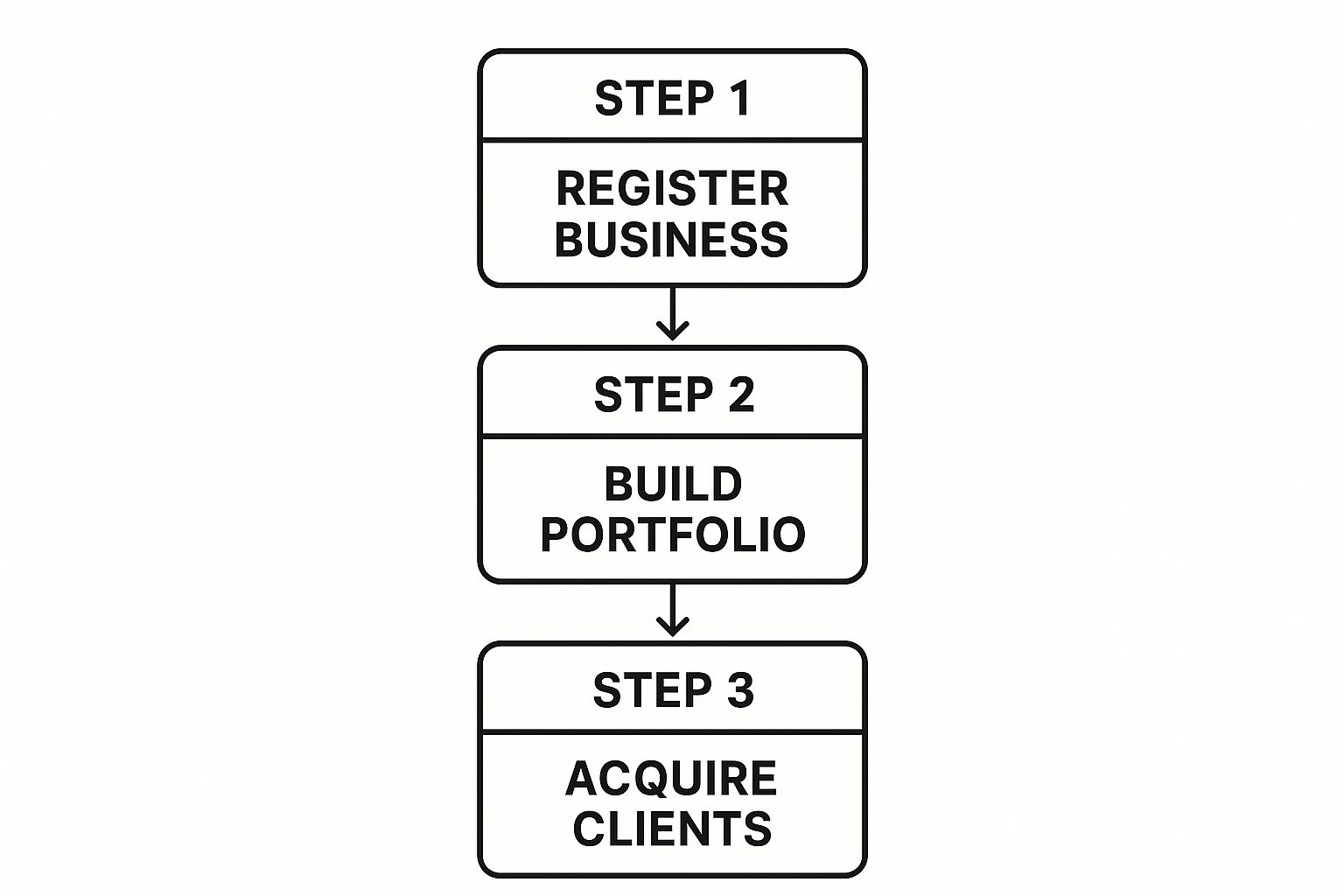
As you can see, getting your business basics sorted comes first. Once your foundation is solid, you can confidently move on to winning work.
Choosing the Right Pricing Model
There’s no magic, one-size-fits-all answer here. The best pricing model really depends on the project, the client's needs, and where you are in your own freelance journey. Let's break down the three most common structures you'll come across.
- Project-Based Fees: This is a fixed price for a specific, well-defined project. Think "develop a three-month content strategy" or "run a Diwali Google Ads campaign." It's perfect for clients who want budget certainty and a clear outcome.
- Monthly Retainers: Here, clients pay you a fixed fee every month for ongoing work like SEO, social media management, or content creation. This model is the holy grail for freelancers because it creates predictable, recurring revenue and helps build solid, long-term relationships.
- Value-Based Pricing: This is the advanced league. You tie your fee directly to the business results you generate—for example, taking a percentage of the revenue from a sales campaign you managed. It requires a ton of confidence in your skills and a client who's willing to share in a high-risk, high-reward partnership.
For most freelancers starting out in India, a blend of project-based fees for one-off jobs and monthly retainers for ongoing clients is a great way to build a stable income stream.
Don't underestimate the earning potential. A PayPal report revealed that the average annual income for a freelance digital marketer in India can hit around ₹25 lakhs. It just goes to show that with the right skills and strategy, this is a seriously viable career path.
A pricing model is only as good as how you present it. That's where a killer proposal comes in.
Crafting Proposals That Convert
Your proposal is your single most important sales document. It’s not just a price list; it’s your chance to convince a client that you are the only solution to their problem. A lazy proposal that just lists tasks is going to get ignored.
To make your proposals impossible to resist, follow this simple formula:
- Lead with Their Problem: Start by showing you've actually listened. Clearly state your understanding of their business challenge right at the beginning.
- Present Your Solution: Lay out your strategy. Don't just list what you'll do; explain why this is the right approach to solve their specific problem.
- Define Clear Deliverables: Get specific. "12 optimised blog posts per quarter" is infinitely better than "content creation." No room for ambiguity.
- Offer Tiered Pricing: Give them options. A Basic, Standard, and Premium package gives the client a sense of control and often nudges them towards the middle tier, which is usually where you want them to land.
And please, don't forget to be crystal clear about payment terms. A solid proposal justifies its price tag by linking every single activity back to the client's business goals. Our guide on how to negotiate payment terms as a freelancer has some great tips for making sure you get paid on time, every time.
Scaling Your Freelance Business with AI

Making the jump from a busy freelancer to a sustainable one-person business isn't about working more hours. It's about working smarter. If you're a freelance digital marketer in India looking to scale without burning out, you have to embrace efficiency. That means moving past manual grunt work and adopting tools that multiply your efforts.
The real secret to scaling is creating repeatable processes. Think about the tasks you do for every single client—weekly reporting, initial keyword research, onboarding checklists. By turning these into templates, you can shave hours off your administrative time and pour that energy back into high-level strategy that clients actually pay for.
Automating the Repetitive Tasks
This is where artificial intelligence becomes your most powerful ally. Don't think of AI as a replacement for your expertise; see it as a force multiplier. Its true value is in taking over the routine, time-consuming tasks that clog up your day.
This frees you up to focus on what truly matters: strategy, creativity, and building strong client relationships.
Here are a few areas where AI can make an immediate impact:
- First-Draft Content: Use AI to generate initial blog outlines, social media captions, or ad copy. This gives you a solid foundation that you can then polish with your unique voice and strategic insights.
- Keyword Research: AI tools can analyse SERPs and uncover long-tail keyword opportunities in minutes. A job that used to take hours of manual digging is now done in a flash.
- Data Analysis: Let AI comb through campaign data to identify trends and performance metrics. It can hand you actionable insights on a silver platter, ready for your next client meeting.
By offloading this work, you reclaim your mental bandwidth for the complex problem-solving that sets you apart. If you're wondering which tools to start with, check out our guide on the best AI content writing tools currently available.
Human Insight Remains Your Biggest Asset
The rise of automation doesn't make human marketers obsolete—it makes our strategic input more valuable than ever. AI is fantastic at execution, but it lacks a nuanced understanding of culture, emotion, and the subtle market shifts that an experienced professional can spot. This balance is especially critical in the diverse Indian market.
In fact, while 94% of organisations in India use AI for marketing tasks, the demand for human expertise is stronger than ever.
A recent study found that over 54% of marketing leaders in India and globally are actively hiring freelancers to complement their AI tools. They rely on the freelance digital marketer in India for the strategic pivots and creative agility that AI alone can’t provide. This highlights a clear trend: technology handles the 'how', while skilled freelancers direct the 'why'.
Ultimately, scaling your business is about intelligently blending technology with your irreplaceable human expertise. Automate the predictable so you can excel at the exceptional.
Navigating Finances and GST in India
Let's talk about the part of freelancing that most creatives try to ignore: money and taxes. I get it, it's not glamorous, but getting your financial house in order from day one is what separates a short-lived gig from a sustainable business. If you neglect this, you're setting yourself up for some serious headaches down the line.
The very first, non-negotiable step is to separate your personal and business finances. Seriously, don't put this off. Open a dedicated business bank account—even a simple current account will do. This creates a clean boundary, making it incredibly easy to track your income, see where your money is going, and not tear your hair out during tax season.
This simple separation also professionalises your invoicing. Whether you use a basic template or an online tool, make sure every invoice includes your details, the client's details, a unique invoice number, a clear description of your services, and the total amount due.
Understanding GST for Freelancers
Ah, the Goods and Services Tax (GST). It can feel intimidating, but the rules for freelancers are actually quite straightforward once you break them down. The main thing you need to watch is your annual turnover.
Right now, if your total freelance income crosses ₹20 lakhs in a financial year, you have to register for GST. For freelancers in certain special category states, that threshold is lower at ₹10 lakhs. It's on you to monitor your income as you get close to this number.
It’s a huge misconception that GST only applies to businesses selling physical products. As a service provider, your digital marketing services absolutely fall under the GST regime once you cross that turnover threshold. Registering proactively doesn't just avoid penalties; it makes you look like a serious business owner.
Once you’re registered, you'll need to issue GST-compliant invoices and file regular returns. Yes, it’s a bit more admin work. But the upside is you can claim Input Tax Credit (ITC) on your business expenses—think software subscriptions, office rent, or even that new laptop. This can actually lower your overall tax bill.
For a deeper dive, our guide on GST registration for freelancers walks you through every single step.
Income Tax and Financial Planning
GST isn't the only tax you need to worry about. You're also responsible for paying income tax on your earnings. Unlike a salaried job where TDS is handled for you, freelancers get paid in full. This means you have to be the responsible one and set money aside for taxes yourself.
A solid rule of thumb is to squirrel away 20-30% of your income from every single payment into a separate savings account just for taxes. Trust me, this habit will save you from a massive panic attack when it's time to pay advance tax or file your annual return.
Finally, get religious about tracking your business expenses. Keep records of everything—your internet bill, software subscriptions, co-working space fees, you name it. These are all legitimate business deductions that can significantly lower your taxable income. You don't need fancy software; a simple spreadsheet or a free accounting app can make this painless and set you up for long-term financial health.
Common Questions for Indian Freelancers

Jumping into any new career is bound to bring up a hundred questions. The path to becoming a freelance digital marketer in India is no different. Let's clear up some of the most common uncertainties I hear from new freelancers, so you can start your journey with confidence.
These are the direct, no-fluff answers I wish I had when I was starting out. They'll help you sidestep common hurdles and build a solid foundation for success.
Do I Need a Degree to Start?
Absolutely not. Let's be clear: a formal degree is not a ticket to success in this game. Most clients in India and abroad care far more about your practical skills, a portfolio that shows what you can do, and any relevant industry certifications you've picked up.
Proven results will always carry more weight than a piece of paper from a university. You can get started by building a portfolio with personal projects or even creating mock campaigns for brands you admire. Back this up with certifications from trusted names like Google, HubSpot, or SEMrush to show clients you're serious and knowledgeable.
How Much Can I Earn in My First Year?
Your first-year earnings can swing quite a bit, but it’s realistic for a new freelance digital marketer in India to pull in anywhere from ₹15,000 to ₹40,000 per month. The goal in year one isn't to get rich quick; it's to land a few great clients who will give you glowing testimonials and solid case studies for your portfolio.
Once you start delivering tangible results and gaining experience, you can—and should—confidently raise your rates. Specialising in a high-demand niche, like performance marketing for e-commerce brands or technical SEO for SaaS companies, is another great way to start commanding higher fees much sooner.
One of the biggest mistakes I see new freelancers make is underpricing their services out of fear. Another common trap is failing to use a clear, professional contract for every single project. These early mistakes can really hurt your long-term confidence and financial stability.
How Do I Handle International Clients and Payments?
Taking on international clients is a brilliant move to grow your business and boost your earning potential. And managing payments is much simpler than you might think.
Here's what you need to keep in mind:
- Payment Platforms: Stick to reliable services like PayPal or Wise to get paid directly. If you're using platforms like Upwork, they have their own built-in systems that handle the entire transaction for you.
- Clear Contracts: Always, always have a contract that clearly states the project currency (e.g., USD) and the payment schedule. No exceptions.
- Tax Compliance: For every payment you receive from an international client, make sure you get a Foreign Inward Remittance Certificate (FIRC) from your bank. This document is absolutely crucial when you file your taxes in India.
At Money Mattr, we give you the financial know-how you need to thrive as a freelancer in India. From mastering GST to smart investment strategies, our resources are built to help you run a profitable and sustainable business. Explore our guides and take control of your financial future today at https://moneymattr.com.

Ayush Gupta is an entrepreneur and SEO consultant with over a decade of experience helping businesses grow. As the founder of Visibility Ventures, he combines technical expertise with practical financial knowledge to guide readers through credit cards, investments, and tax optimization. He holds certifications in Entrepreneurship and Business Laws from NUJS Kolkata and regularly advises companies on digital growth strategies.