

So, you want to start freelancing in India?
The first steps are pretty straightforward: figure out a skill people will pay for, whip up a portfolio that shows you know your stuff, and get yourself set up on platforms like Upwork or LinkedIn.
After that, it’s all about nailing your pricing, finding clients, and getting a handle on invoicing and payments.
The Reality of Freelancing in India Today
Let’s get one thing straight: freelancing in India isn’t just a side gig for a little extra pocket money anymore.
For millions, it’s a serious, full-time career path.
People aren’t just running away from the 9-to-5; they’re actively building independent businesses that give them control, flexibility, and a direct line to clients all over the world.
The numbers don’t lie.
India’s freelance workforce has exploded to about 15 million professionals.
This isn’t a slow crawl—it’s a rocket ship.
Just between the first two quarters of 2025, the number of new freelancers shot up by a staggering 46%.
A huge chunk of this growth, 55% to be exact, comes from young pros between 21 and 29. You can dig into more stats and see just how India is becoming a global freelance hub.
Why This Path Is More Accessible Than Ever
Jumping into freelancing might feel like a huge leap, but honestly, the barriers have never been lower. Thanks to a whole universe of digital tools and online platforms, you don’t need a fancy office or a pile of cash to get started.
So, what does that actually mean for you?
- Turn Skills into Cash: Got a knack for writing, graphic design, coding, or marketing? You can start selling that skill directly. No middleman needed.
- Go Global from Home: Platforms like Upwork, Fiverr, and even LinkedIn are your gateways to businesses not just in India, but across the globe. Your market just got a whole lot bigger.
- Keep Costs Down: Your biggest investments are your skills, a decent internet connection, and your time. It’s a financially smart way to start a business.
Here’s the single most important piece of advice I can give you: stop thinking like an employee waiting for a to-do list. Start thinking like a business owner who solves problems for clients. That mental shift will change everything.
Your Initial Freelance Roadmap
Wingin’ it won’t get you very far.
You need a game plan.
While everyone’s freelance journey looks a bit different, the core steps are the same for everyone.
Before you even think about landing that first client, you need to build a solid foundation.
This is what stops you from falling into common traps like under-charging or struggling to find work a few months down the line.
This guide is your step-by-step preview of the road ahead.
No fluff, just practical advice to help you get started with confidence.
To give you a quick overview, here are the essential milestones you’ll be hitting.
Think of this as your high-level checklist for getting your freelance business off the ground.
Your Freelance Launch Checklist
| Milestone | Key Action | Why It Matters |
|---|---|---|
| Skill & Niche | Identify one profitable skill and a specific target market. | Specializing makes you an expert, not a generalist, which attracts better-paying clients. |
| Portfolio | Create 3-5 high-quality samples that showcase your best work. | A strong portfolio is your single most important sales tool. It’s proof you can deliver. |
| Online Presence | Set up profiles on 1-2 key freelance platforms (like Upwork or Fiverr). | This is where your clients are. An optimized profile acts as your digital storefront. |
| Pricing | Research industry rates and set your starting prices. | Pricing right from day one avoids the trap of being seen as “cheap” and builds confidence. |
| Client Outreach | Develop a simple, repeatable process for finding and pitching clients. | Consistent outreach is the engine of your business. No outreach, no clients. |
Following these steps in order will build momentum and set you up for long-term success, helping you avoid the classic mistakes many new freelancers make.
Building Your Freelance Foundation

Before you even think about sending that first cold email or setting up a profile on Upwork, the real work begins.
It’s the foundational stuff that most people skip, and it’s what separates the freelancers who are always scraping by from those who build a truly profitable business.
Successful freelancing in India isn’t about being good at a bunch of things.
It’s about being absolutely brilliant at one thing for a very specific group of people.
Let’s start with a brutally honest look at your skills.
For a moment, forget what you’re passionate about and get real about what the market actually pays for.
What skills do you have right now that businesses are desperate to find?
Don’t just think in broad strokes.
“Writing” or “design” is too vague.
Are you a pro at writing technical documentation for SaaS companies?
A whiz at crafting snappy social media captions that get clicks?
Maybe you design user interfaces for mobile apps that people can’t put down. Your sweet spot is where your genuine talent meets a burning market need.
Find Your Profitable Niche
Once you’ve pinpointed your core skill, your next mission is to niche down. Seriously.
Trying to be a “generalist” in the crowded Indian freelance market is a one-way ticket to obscurity.
When you market yourself to everyone, you connect with no one.
Niching down is about becoming the undisputed expert for a particular type of client or industry.
This focus is your superpower.
It lets you command higher rates, build a portfolio that screams “I get you,” and makes your marketing a whole lot easier.
You stop being just another freelancer and become a specialist.
Think about the difference here:
- Generalist: A graphic designer who does logos, brochures, and social media posts for anyone who’ll pay.
- Specialist: A graphic designer who creates packaging and branding exclusively for Indian D2C food brands.
Who do you think a new artisanal coffee brand is going to hire? The specialist, every single time. Their entire business is tuned to solving that specific client’s problems.
The aim is to make a potential client feel like you were put on this earth just for them. When a FinTech startup in Bengaluru needs a writer, they’re not looking for a “Freelance Writer.” They’re looking for the “SEO Content Strategist for Indian FinTech Companies.” Be that person.
Create Your Ideal Client Profile
Now that you know your niche, it’s time to paint a crystal-clear picture of the exact person or company you want to work with.
This isn’t just a marketing exercise; it’s a strategic filter that will save you from wasting countless hours on clients who are a terrible fit.
An ideal client profile (ICP) goes way beyond basic details.
It gets into the psychology of your target and the real-world problems they’re facing.
Ask yourself these questions to build your ICP:
- Industry: Which specific sector are they in? (e.g., SaaS, EdTech, sustainable fashion)
- Company Size: Are you targeting a solo founder, a small startup of 5-10 people, or a bigger mid-sized company?
- Their Problem: What specific pain point are they wrestling with that you can solve? (e.g., “Our website traffic is flat,” “User engagement on our app is terrible,” “Our brand messaging is all over the place.”)
- Their Values: What’s important to them? (e.g., data-driven results, creative innovation, social impact)
- Where They Hang Out Online: Where do they spend their time? (e.g., LinkedIn groups for SaaS founders, specific industry forums, Twitter)
Having this clarity turns your client search from a random shot in the dark into a precision-guided mission.
As your freelance venture grows, you’ll naturally start thinking about making things more official.
If you’re wondering when to make that leap, our guide on when to register a company as you transition from freelancer to business owner has some great insights.
Getting this foundation right is everything.
Crafting a Portfolio That Attacks Clients

Let’s be clear: your portfolio is your single most important sales tool.
It’s not just a collection of your work; it’s the hard proof that you can actually deliver results.
Forget your CV—a great portfolio tells a potential client everything they need to know about your skills and the value you bring to the table.
Of course, this leads to the classic dilemma every new freelancer in India faces: “How do I build a portfolio without any experience?” It’s a frustrating cycle.
You need work to build a portfolio, but you need a portfolio to get work.
The answer is simpler than you think: you create your own experience.
Don’t wait for someone to give you a chance. Proactively build a body of work that showcases the exact skills you want to sell.
A tight, focused portfolio with three to five high-quality, relevant pieces is far more powerful than a messy collection of dozens of mediocre or unrelated samples.
Building Your Portfolio From Scratch
If you have zero paid projects under your belt, the first move is to create speculative work.
These are self-initiated projects you design to solve a real-world problem for the exact type of client you want to attract.
Think of it this way.
If your dream client is an Indian EdTech startup, don’t just write a generic blog post. Instead, create a full-blown content strategy proposal for a fictional EdTech app.
Include sample blog posts, social media copy, and even a mock-up of a landing page.
This shows you’re not just a writer; you’re a strategic thinker who understands their industry inside and out.
Here are a few practical ways to build your initial portfolio:
- Create Speculative Projects: Invent a client or pick a real brand you admire. Then, create a project for them as if they’d hired you. A designer could mock up a complete rebranding concept; a writer could craft a full email marketing sequence.
- Develop Case Studies From Past Jobs: Think about a big win from a previous full-time role. Did you help increase sales by 15% with a campaign you managed? Turn that into a detailed case study. Outline the problem, explain your solution, and highlight the measurable results.
- Offer a Skill Swap: Find another new freelancer—maybe a web developer if you’re a writer—and trade services. You write their website copy, and they build your portfolio site. It’s a win-win that gives you both a real-world project to showcase.
A portfolio isn’t just about showing off pretty designs or well-written articles. It’s about proving you can solve business problems. Frame every piece in your portfolio around the result it was designed to achieve.
Optimizing Your Online Profiles
Once you have your core samples ready, it’s time to translate that into a compelling online presence.
Platforms like Upwork, Freelancer, and LinkedIn are often the first places potential clients will find you.
Your profile isn’t just a resume; it’s your digital storefront.
Your headline is everything. It needs to stop scrollers in their tracks and immediately communicate your value.
Check out the difference between a weak headline and a powerful one:
| Ineffective Headline | Effective Headline |
|---|---|
| “Freelance Content Writer” | “SEO Content Writer for Indian B2B SaaS Startups” |
| “Graphic Designer” | “Brand Identity Designer for D2C E-commerce Brands” |
The second option in each example is specific, speaks directly to a niche, and positions the freelancer as a specialist, not just another generalist.
It’s a simple change that makes a world of difference in how clients perceive you.
Presenting Your Work Effectively
How you present your work is just as important as the work itself.
Simply uploading a PDF or dropping a link isn’t going to cut it.
You need to provide context that walks the client through your thought process and highlights your strategic contribution.
For every single project in your portfolio, include a brief description covering these three things:
- The Client’s Problem: What challenge were they facing? (e.g., “The client was struggling with low organic traffic and poor lead generation from their blog.”)
- Your Specific Role: What exactly did you do? (e.g., “I developed a six-month content strategy, wrote 12 SEO-optimized articles, and created a lead magnet to capture emails.”)
- The Tangible Result: What was the outcome? Use numbers whenever you can. (e.g., “This resulted in a 40% increase in organic traffic and a 25% uplift in marketing-qualified leads within three months.”)
This simple structure transforms a basic work sample into a powerful success story.
It shows clients that you’re not just a “doer”; you’re a problem-solver who delivers measurable value.
This kind of professional branding builds immediate trust and helps you stand out in the crowded Indian freelance market.
Pricing Your Services and Managing Your Money
Figuring out what to charge is easily one of the most stressful parts of starting out as a freelancer in India.
If you price too high, you worry about scaring off potential clients.
But if you price too low, you risk getting trapped in a cycle of being overworked and underpaid—a classic beginner’s mistake.
Getting your pricing right from day one is about more than just making money.
It’s about cementing your value and building a business that can actually last.
The good news? The potential to earn well is very real.
Freelancer earnings in India have seen incredible growth, surging by an estimated 138% between 2020 and 2025.
This jump was driven by massive demand in fields like IT, design, and content.
In fact, a whopping 60% of freelancers report earning more than they did in their old full-time jobs.
Choosing Your Pricing Model
There’s no magic formula for pricing your services.
The best model for you will depend on your niche, your experience, and the kind of work you do.
Let’s break down the three most common structures you’ll come across.
- Hourly Rate: This is straightforward—you charge for every hour you put in.
It’s a great fit for projects where the scope isn’t clearly defined or for ongoing work like social media management.
The catch? You’re trading time for money, which puts a ceiling on how much you can earn.
- Per-Project Fee: You quote one flat fee for the entire project.
This works perfectly for well-defined deliverables, like designing a five-page website or writing a series of four blog posts.
It lets you price based on the value you deliver, not just the hours you clock, which rewards you for being efficient and skilled.
- Retainer Fee: This is the holy grail for freelancers.
A client pays you a fixed amount every month for a certain amount of work or simply to have you on call.
It creates predictable, stable income and is ideal for long-term client relationships.
Pro Tip: When you’re just starting, a per-project fee is often your best bet. It forces you to get good at estimating your time and defining the project scope upfront—two skills that are absolutely essential for a successful freelance career.
How to Confidently Set Your Rates
Undercharging is an epidemic among new freelancers.
To sidestep this, you need to do a bit of homework.
Start by researching what other freelancers in your specific niche, with a similar level of skill, are charging in India.
Spend some time on platforms like Upwork and LinkedIn.
Check out the profiles of successful freelancers in your field.
What rates do they mention? What kind of projects are they landing? Don’t just copy their numbers blindly; use them as a realistic benchmark to build your own pricing strategy.
This infographic gives a simple flow for how to turn that research into a proposal that wins clients.
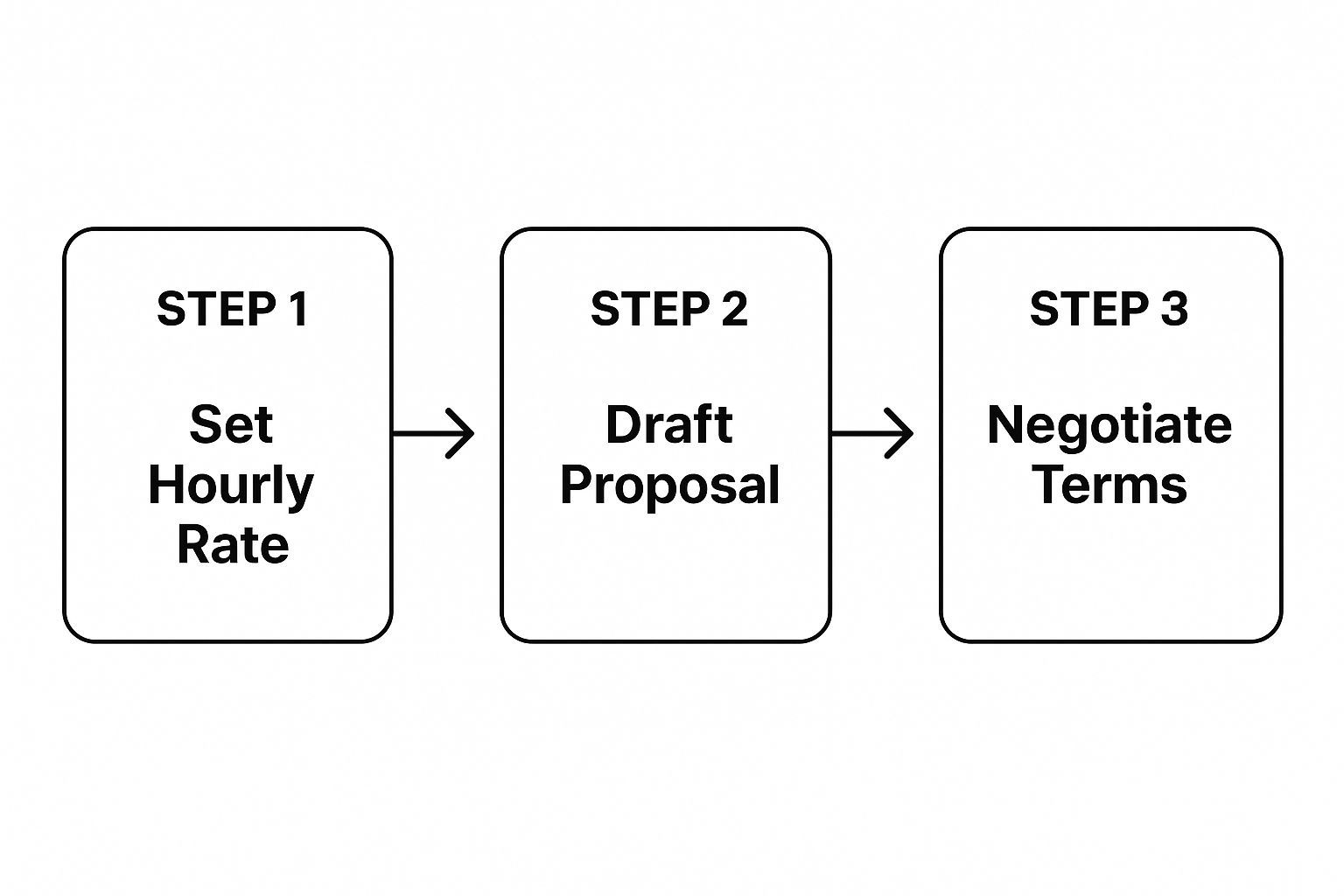
As you can see, setting a base rate is just step one.
The real magic happens when you craft a proposal that screams value and you’re ready to confidently negotiate your terms.
Managing Your Freelance Finances
Once the money starts rolling in, you have to switch gears and think like a business owner, not an employee waiting for a monthly salary.
Financial discipline is non-negotiable if you want to make it as a freelancer in India.
Your absolute first move should be to open a separate bank account just for your business income.
Mixing personal and business finances is a recipe for disaster, especially when tax time comes around.
A dedicated account gives you a crystal-clear view of your cash flow.
If you’re not sure what to open, you can explore the differences between a current account vs saving accounts to see what makes the most sense for you.
Next up, invoicing.
Your invoice is more than just a bill; it’s a professional document that reflects your brand.
Make sure every invoice includes:
- Your name and contact details
- The client’s name and contact details
- A unique invoice number and date
- A clear, itemized breakdown of the services you provided
- Your payment terms (e.g., “Due within 15 days”)
- Your bank account details or UPI ID for easy payment
Finally, keep a close watch on your total turnover, because GST (Goods and Services Tax) will eventually come into play.
In India, you’re required to register for GST if your annual turnover from services crosses ₹20 lakhs.
You don’t need to stress about this on day one, but it’s a critical milestone to have on your radar.
Tracking your income meticulously from the very beginning will make sure you’re prepared and compliant when you hit that threshold.
Strategies for Landing Your First Clients

Alright, your portfolio is polished and your rates are set.
Now comes the exciting part: finding people who will actually pay you.
Let’s be clear, landing your first clients is an active sport. Just building a profile and waiting for the magic to happen is a recipe for frustration.
Your mission is to get your value in front of the right eyeballs, consistently.
This means a smart mix of using freelance marketplaces for quick wins and direct outreach to build long-term, high-value relationships.
Mastering Freelance Marketplaces
Freelance platforms are the modern-day bazaar for Indian freelancers.
You just can’t ignore them.
The market is projected to hit US$775.6 million by 2030, and these platforms are a massive chunk of that pie.
You can read more about the growth of India’s freelance platform economy to see just how big this is.
But success on giants like Upwork or Freelancer isn’t about spamming dozens of generic bids.
It’s all about quality over quantity.
Think of your proposal as your first sales pitch—it has to be sharp.
The biggest mistake beginners make? Starting the proposal by listing their skills.
The client assumes you have the skills; that’s why you applied. Instead, flip the script and make it all about their problem.
- Show You Get It:
Kick things off by proving you’ve actually read their project description.
A simple sentence like, “I see you’re looking to drive more organic traffic to your new D2C website…” instantly builds a connection.
- Hint at a Solution:
Briefly outline how you’d tackle their project.
This isn’t about giving away the full strategy, but offering a peek into your thinking process that screams “expert.”
- Link it to Your Work:
Point them to a specific piece in your portfolio that’s a perfect match for what they need.
For example, “My work with [Previous Client/Spec Project] had a similar goal, where we increased their leads by 20%.”
Your proposal should feel less like a CV and more like a mini-consultation. The moment you shift from “Here’s what I can do” to “Here’s how I can solve your problem,” your response rate will shoot up. I promise.
Powerful Off-Platform Strategies
While platforms are a fantastic starting point, the real money and the best long-term relationships are usually found off-platform.
This is where you take the reins, identifying and connecting directly with your dream clients without a middleman taking a cut.
Here’s a quick look at how different channels stack up.
Client Acquisition Channels Comparison
Finding clients isn’t a one-size-fits-all game.
Some methods are quick but competitive, while others require more legwork but can lead to much more rewarding partnerships.
This table breaks down the most common channels so you can decide where to focus your energy first.
| Channel | Effort Level | Potential Payout | Best For |
|---|---|---|---|
| Freelance Platforms | Low to Medium | Low to Medium | Beginners needing to build a portfolio and get initial reviews. |
| Cold Emailing | Medium to High | Medium to High | Targeting specific, high-value clients with a personalized pitch. |
| LinkedIn Networking | Medium | Medium to High | Building authority in a niche and attracting inbound leads. |
| Personal Network | Low | Low to High | Landing your very first project quickly through warm referrals. |
Ultimately, a mix of these strategies is your best bet.
Start on platforms to get moving, but begin planting seeds with direct outreach and networking for future growth.
The Art of the Targeted Cold Email
Yes, cold emailing still works—but only if it’s not actually cold.
Your email needs to be warm, personal, and focused on giving value, not just asking for work.
- Find a Real Person: Never, ever email a generic “info@” address. Hop on LinkedIn and find the head of marketing, the founder, or the specific person who would hire you.
- Lead with a Real Compliment: Show you’ve done your homework. Mention a recent blog post they wrote, a product they just launched, or something specific you admire about their brand.
- Offer a Bite-Sized Tip: Give them a tiny piece of value for free. A writer could suggest a new blog topic with a killer headline. A designer might point out a small UI tweak on their website.
- Keep the Ask Small: Don’t ask for a job. Instead, ask if they’d be open to a quick 15-minute chat about their content strategy or branding goals. It’s a much lower bar to clear.
Genuine Networking on LinkedIn
LinkedIn is your most powerful tool for building a professional brand.
First, make sure your profile is fully optimized with a specialist headline.
Then, it’s time to engage—the right way. This is not about sending spammy connection requests.
- Follow Target Companies: Keep an eye on their updates and news.
- Engage with Their Posts: Don’t just “like” posts from people at companies you admire. Leave a thoughtful, insightful comment that adds to the conversation.
- Share Your Expertise: Post short tips, quick insights, or results from your projects. This slowly positions you as a go-to expert and starts attracting people to you.
Tap Into Your Existing Network
Last but not least, never underestimate the power of the people you already know.
Your very first client could easily be a former boss, a friend’s colleague, or someone in your extended family.
Let everyone know what you’re up to. Post a simple, professional announcement on your personal social media profiles.
You aren’t asking for a handout; you’re just informing your network about the professional services you now offer.
This “warm market” is often the quickest path to landing that crucial first project and getting the testimonials you need to really kickstart your freelance career in India.
Navigating Common Freelance Challenges in India
Starting your freelance journey in India is an exciting venture, but let’s be realistic—it’s not always smooth sailing.
Every successful freelancer I know has navigated a minefield of common problems, from clients who disappear on payment day to the confusing world of taxes.
Knowing what you’re up against is your best defense.
Here, we’ll tackle the most frequent hurdles new Indian freelancers face, giving you direct, actionable answers to manage your business with confidence.
Dealing with Unpredictable Income
One of the first shocks for many new freelancers is the shift from a predictable monthly salary to a fluctuating income.
One month you might feel on top of the world, and the next, you’re anxiously checking your bank balance.
This feast-or-famine cycle can be incredibly stressful.
The key to surviving this is to get proactive with your financial planning.
Stop thinking about your income in monthly terms; instead, zoom out and focus on your quarterly and annual earnings. That’s the real picture.
To smooth out the bumps, building a financial buffer is non-negotiable.
- Build an Emergency Fund: Your first goal should be to save at least three to six months’ worth of essential living expenses. This fund is your safety net for quiet months, unexpected costs, or if you just need to take a break.
- Budget Based on Your Average: Never budget based on your best month. Calculate your average monthly income over a three-month period and base your personal spending on that number.
- Diversify Your Client Roster: Relying on one client for more than 50% of your income is a massive risk. Actively work towards having three to five regular clients. This ensures that losing one won’t cripple your finances overnight.
The goal isn’t just to earn money; it’s to create predictable cash flow. A freelancer who earns a consistent ₹70,000 every month is in a much stronger financial position than one who earns ₹2 lakhs one month and nothing for the next two.
Handling Late or Non-Paying Clients
Chasing payments is, unfortunately, part of the freelancing life.
It’s frustrating, time-consuming, and can seriously mess with your cash flow.
While most clients are professional, you will almost certainly encounter someone who pays late or tries to ghost you completely.
Prevention is always better than a painful cure.
Your first and best line of defense is a rock-solid contract or service agreement.
Before you write a single word or design a single pixel, make sure you have a written agreement that clearly outlines the project scope, deliverables, and—most importantly—the payment terms.
Get crystal clear on your payment terms.
- Get an Upfront Deposit: For any new client or large project, always ask for a 30-50% deposit upfront. It secures their commitment and covers your initial time investment. No exceptions.
- Use Milestone Payments: Break down large projects into smaller, manageable phases. Invoice the client as each milestone is completed (e.g., after the first draft, after the prototype is approved).
- Include Late Payment Penalties: State clearly in your contract that a late fee (like a 2-5% interest charge per month) will be applied to overdue invoices. This simple clause gives clients a good reason to pay on time.
If a client does go silent, don’t panic. Start with a polite email reminder.
If that doesn’t get a response, you’ll need to escalate your approach.
Knowing how to professionally and legally pursue what you’re owed is a crucial skill. You can learn more about the specific steps and legal options for handling late payments in our detailed guide for Indian freelancers.
Understanding Taxes and GST Compliance
Taxes. The one word that makes most new freelancers nervous.
But ignoring them is a recipe for a much bigger headache down the line.
As a freelancer in India, you are a business owner, and that means you’re responsible for your own taxes.
The Indian tax system treats your freelance income as “Profits and Gains from Business or Profession.” It’s essential to keep meticulous records of all your income and business-related expenses.
Why? Because you can claim deductions for things like your internet bill, software subscriptions, co-working space fees, and more.
Many freelancers find the Presumptive Taxation Scheme under Section 44ADA of the Income Tax Act to be a lifesaver.
| Presumptive Taxation (Section 44ADA) | Key Features |
|---|---|
| Eligibility | For specified professionals with a gross annual income under ₹50 lakhs. |
| How It Works | You simply declare 50% of your total income as profit and pay tax on that amount according to your slab. |
| The Big Benefit | It dramatically simplifies tax filing. You’re not required to maintain detailed books of accounts. |
GST registration is the other big piece of the puzzle.
You are legally required to register for GST if your annual turnover crosses ₹20 lakhs.
Even if you’re below this threshold, you might need to register if you’re providing services to clients outside India, as this is considered an “inter-state supply.”
Keep a close eye on your revenue from day one. It will ensure you register on time and avoid nasty penalties. Seriously, one of the smartest investments you can make once you start earning consistently is to consult a chartered accountant (CA).
At Money Mattr, we’re committed to breaking down complex financial topics into easy-to-understand guides.
Whether you’re just starting or looking to scale your freelance business, we provide the knowledge you need to manage your money with confidence. Explore more resources and tools at https://moneymattr.com.

Ayush Gupta is an entrepreneur and SEO consultant with over a decade of experience helping businesses grow. As the founder of Visibility Ventures, he combines technical expertise with practical financial knowledge to guide readers through credit cards, investments, and tax optimization. He holds certifications in Entrepreneurship and Business Laws from NUJS Kolkata and regularly advises companies on digital growth strategies.